The Big Blowup: 1910 Wildfires Reshape Forest Management and Firefighting
In late summer 1910, a series of devastating wildfires, known as the "Big Blowup," swept through Idaho, Montana, and Washington. These fires killed at least 87 people and burned approximately 3 million acres, leading to significant changes in wildfire monitoring…
 Salt Lake City, UT, August 20, 2026 —
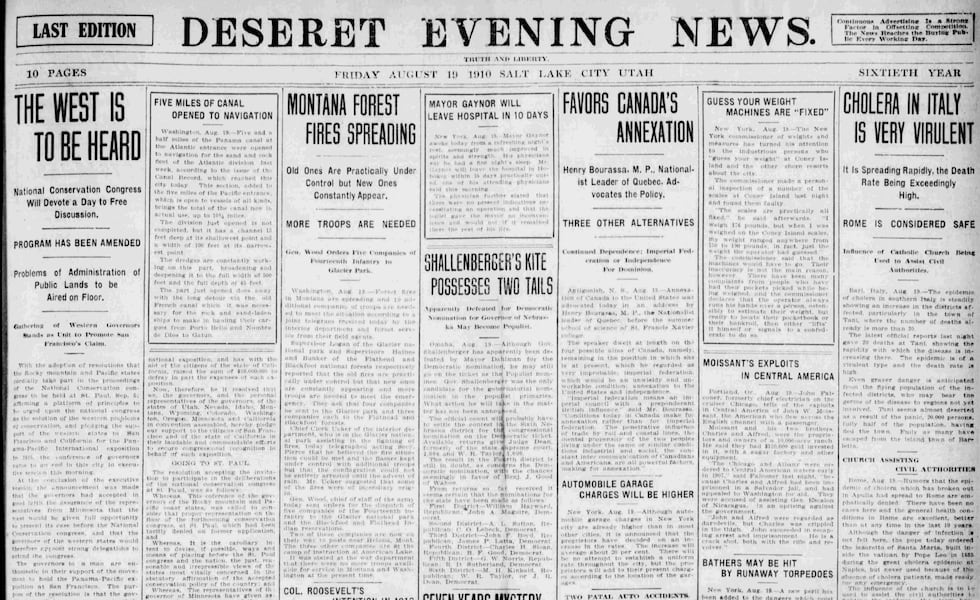
In the late summer of 1910, a catastrophic series of wildfires, collectively known as the “Big Blowup,” ravaged vast swaths of the American West, leaving a legacy of devastation and fundamentally altering approaches to forest fire management and suppression.
The infernos, which swept through Idaho, Montana, and Washington, resulted in the tragic deaths of at least 87 people. The fires consumed an estimated 3 million acres of land, creating a landscape scarred by their intensity and marking one of the most severe fire events in U.S. history.
The aftermath of the Big Blowup spurred significant advancements in how wildfires were monitored and fought. Key developments included the conceptualization and implementation of fire lookout towers, providing crucial vantage points for early detection, and the enhancement of communication tools to better coordinate firefighting efforts across rugged terrain.
Among the figures recognized for their actions during this period was Ranger Ed Pulaski. He is credited with saving the majority of his firefighting crew and with developing the specialized tool that bears his name. The Pulaski, a combination axe and adze, remains an essential piece of equipment for firefighters to this day, a testament to its effective design born out of necessity.
The destructive potential demonstrated by the Big Blowup was not an isolated incident. The summary notes that the propensity for large-scale wildfires in the Western United States has seen a continued increase in the decades following the 1910 event, underscoring the enduring challenge of managing these natural forces.
Story summarized from the original created by Chris Miller on www.deseret.com, see more information here.
Media gallery