Biosphere 2 Experiment: A Two-Year Test of Closed Ecological Systems Launched in 1991
The Deseret News archives highlight the Biosphere 2 experiment, which began on September 26, 1991, in Oracle, Arizona. The project involved eight individuals living for two years inside a sealed, 3-acre structure designed to demonstrate the viability of closed ecological…
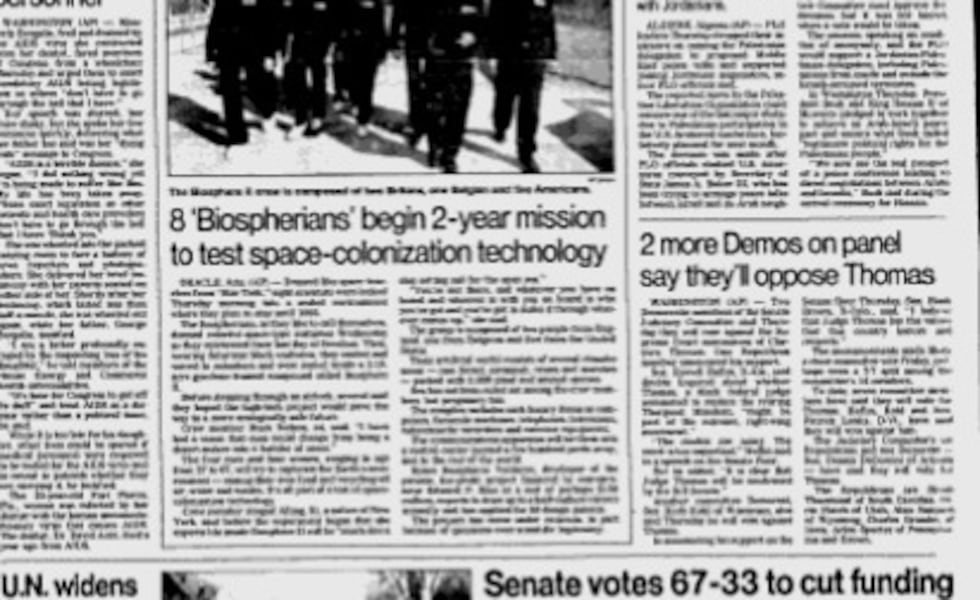
 Salt Lake City, UT, September 26, 2026 — The ambitious Biosphere 2 experiment, a pioneering endeavor to test the feasibility of closed ecological systems for long-term human habitation, commenced on September 26, 1991, in Oracle, Arizona. This groundbreaking project, documented in the archives of the Deseret News, aimed to confine a crew of eight individuals within a meticulously engineered, sealed environment for a period of two years.
The Biosphere 2 structure itself was a vast, 3-acre complex designed to replicate various biomes and sustain life independently of the outside world. Its primary objective was to demonstrate whether such a self-contained ecosystem could successfully support human existence, providing all necessary air, water, and food. The experiment was seen as a critical precursor to potential human settlements on other planets, offering insights into the challenges and requirements of sustaining life in extraterrestrial environments.
The crew embarked on this unprecedented mission, committing to two years within the sealed confines. Their daily lives and the ecological dynamics within the Biosphere were subjects of intense scientific observation and public interest. The project sought to understand the complex interactions between humans and their environment in a completely isolated setting.
While the summary highlights the project’s commencement, duration, and core purpose, further details regarding specific outcomes, challenges encountered by the crew during their two-year stay, or any subsequent phases of the Biosphere 2 experiment were not provided in the available information. The long-term implications for space exploration, a key aspect of its design, remain a significant area of study stemming from such early, large-scale closed-system experiments.
Story summarized from the original created by Chris Miller on www.deseret.com, see more information here.
Media gallery