AI Chip Market to Grow at 22% CAGR Through 2032 as Hyperscaler Custom Silicon Reshapes Semiconductor Demand
Makreo Research reports 22% CAGR in the global AI chip market to 2032, driven by USD 6.7T data centre investment and
Press Release Disclaimer: This is a press release distributed through the XPR Media network. It has not been independently verified by our newsroom.
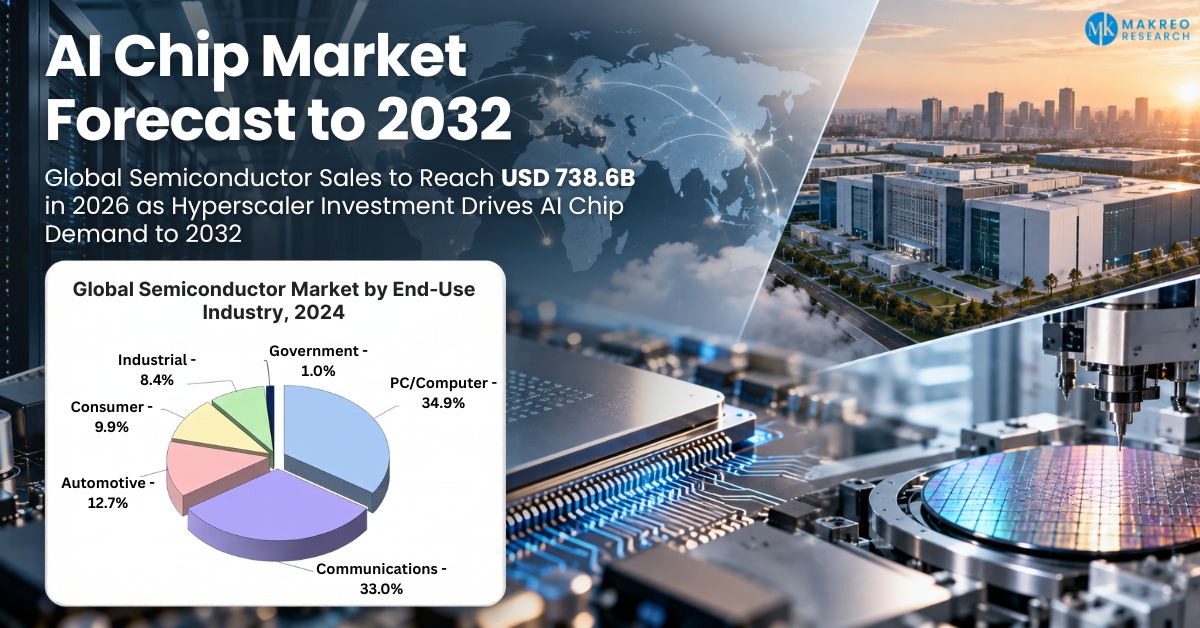

Makreo Research reports 22% CAGR in the global AI chip market to 2032, driven by USD 6.7T data centre investment and hyperscaler custom silicon development.
MUMBAI, MAHARASHTRA, INDIA, September 21, 2026 /EINPresswire.com/ — The global Artificial Intelligence (AI) chip market is entering a new phase of expansion as hyperscaler capital expenditure, generative AI adoption, custom silicon development, and semiconductor policy reshape investment across the global technology and data centre landscape.
According to Makreo Research’s AI Chip Market and Forecast to 2032, the global AI chip market is projected to grow at approximately 22% CAGR between 2027 and 2032, supported by rising hyperscaler investment, expanding AI data centre infrastructure, and continued advances across GPUs, ASICs, custom accelerators, and high-bandwidth memory technologies.
Global semiconductor sales are projected to reach USD 738.6 billion in 2026, while AI-specific data centre power demand is projected to increase from 44 GW in 2025 to 155 GW by 2030, representing a 3.5-fold increase. Global investment in AI data centre infrastructure is expected to exceed USD 6.7 trillion between 2025 and 2030.
AI Data Centre Expansion Becomes a Major Driver of Chip Demand –
Semiconductors are foundational to AI infrastructure economics, accounting for more than 95% of the content value of a leading AI server rack. Annual semiconductor revenue deployed in AI data centres is projected to exceed USD 1.2 trillion by 2028, a nearly tenfold increase compared with four years earlier, as hyperscalers continue investing in large-scale computing capacity.
AI Chip Market Share: NVIDIA Dominance and Hyperscaler Custom Silicon –
A defining development in 2026 is the accelerating shift by major cloud operators toward proprietary AI accelerators. GPUs remain the dominant chip type by volume owing to their parallel-processing advantage for training large-scale AI models. NVIDIA continues to command an estimated 70%-plus share of the AI accelerator market, though hyperscalers including Google, Amazon, and Apple are advancing proprietary silicon such as TPU v5, Trainium 2, and Neural Engine to reduce dependence on merchant GPU supply. NVIDIA’s second-quarter fiscal 2027 results reinforce this momentum: Data Centre revenue reached USD 89.0 billion, up 117% year-on-year and approximately 92% of total company revenue.
Semiconductor M&A and AI Chip Supply Chain Investment in 2026 –
Chipmakers are diversifying beyond general-purpose GPUs into specialised inference silicon. Notable 2026 transactions include:
• AMD’s agreement to acquire Toronto-based Taalas, a startup hardwiring AI model weights directly into silicon for high-speed inference
• Qualcomm’s multi-generation collaboration with Amazon Web Services on customised AI-inference chips and advanced optical connectivity
• Microchip Technology’s agreement to acquire Israeli edge-AI processor developer Hailo
• ON Semiconductor’s approximately USD 7 billion acquisition of Synaptics, extending its reach into “physical AI” applications
These transactions signal a shift toward heterogeneous AI infrastructure, where GPUs and purpose-built accelerators operate alongside one another.
Regional AI Chip Market Analysis –
Regional dynamics continue to diverge across leading semiconductor economies:
• United States: leads global AI infrastructure deployment, with accelerated AI servers accounting for approximately 98% of total AI server spending in 2025 and the country contributing 12.1% of global AI patent grants in 2024
• China: led global AI patent activity overall in 2024, accounting for 74.2% of all grants, reinforcing its position in AI innovation even as export restrictions continue to reshape its access to advanced semiconductors
• South Korea: emerged as a significant new centre of investment in 2026, with the government unveiling a national chip and AI strategy that commits Samsung Electronics and SK Hynix, together with suppliers, to new semiconductor fabrication capacity as part of a broader infrastructure push spanning chips, physical AI, and data centres
• Europe: AI chip market revenue is estimated to reach USD 45.35 billion in 2026, supported by expanding sovereign AI compute initiatives in France and Germany’s continued leadership in industrial AI hardware investment
AI Accelerator Competitive Landscape and Inference Chip Race –
Competitive intensity in the AI accelerator market is increasing as Chinese chipmakers work to close the compute gap with US suppliers. Huawei has moved forward the planned launch of its next-generation Ascend 960DT AI chip to the first quarter of 2027, three quarters ahead of its original roadmap, as part of a strategy to link hundreds of thousands of AI chips into large-scale computing systems for training and inference. NVIDIA has separately entered early-stage discussions with South Korean AI chip designer Rebellions on a potential technology partnership, investment, or acquisition, underscoring how competition for inference-focused silicon is intensifying alongside the established training-chip market.
AI Infrastructure Investment Outlook
Makreo Research expects the AI chip market to remain shaped by sustained hyperscaler capital expenditure and continued diversification across chip architectures, processing environments, and end-user industries through 2032.
The implications of this market shift vary by stakeholder:
• AI infrastructure investors: the shift toward proprietary silicon and consolidation activity is reshaping where capital allocation and market share gains are concentrated across the semiconductor value chain
• Semiconductor manufacturers: supply chain diversification, advanced packaging capacity, and regional fabrication investment are becoming central to competitive positioning through 2032
• Enterprise technology buyers: procurement strategy is increasingly shaped by chip availability, the total cost of AI infrastructure ownership, and vendor diversification across GPU, ASIC, and custom silicon options
As hyperscalers, chipmakers, and governments continue to commit capital at an unprecedented scale, the investment question is shifting from how much AI compute capacity the market can add to where that capacity can be developed with the strongest combination of chip supply, power availability, and geopolitical resilience.
Makreo Research and Consulting’s AI Chip Market and Forecast to 2032 analyses market performance, segmentation, competitive positioning, technology developments, regulatory landscape, and regional dynamics across the global AI chip ecosystem. Organisations assessing AI chip investment, semiconductor market entry, or technology procurement can also explore Makreo’s semiconductor reports and consulting services for decision-ready intelligence across global semiconductor and AI chip markets.
Companies Covered in Global AI Chip Market
NVIDIA Corporation Intel Corporation
Advanced Micro Devices, Inc.
SK hynix Inc.
Samsung Electronics Co., Ltd.
Micron Technology Inc.
The study covers a total of 18 global AI chip market companies.
Related Reports:
Asia Pacific AI Chip Market and Forecast to 2032
Saurabh Adsule
Makreo Research and Consulting
+91 96196 99069
email us here
Legal Disclaimer:
EIN Presswire provides this news content “as is” without warranty of any kind. We do not accept any responsibility or liability
for the accuracy, content, images, videos, licenses, completeness, legality, or reliability of the information contained in this
article. If you have any complaints or copyright issues related to this article, kindly contact the author above.

Media gallery