
Luxury Goods Market: Digital Luxury, Premiumization & Changing Consumer Preferences to Drive 4.72% CAGR Through 2035
Luxury Goods Market is projected to reach USD 761.54 billion by 2035, driven by digital retail, premiumization, watches
Press Release Disclaimer: This is a press release distributed through the XPR Media network. It has not been independently verified by our newsroom.
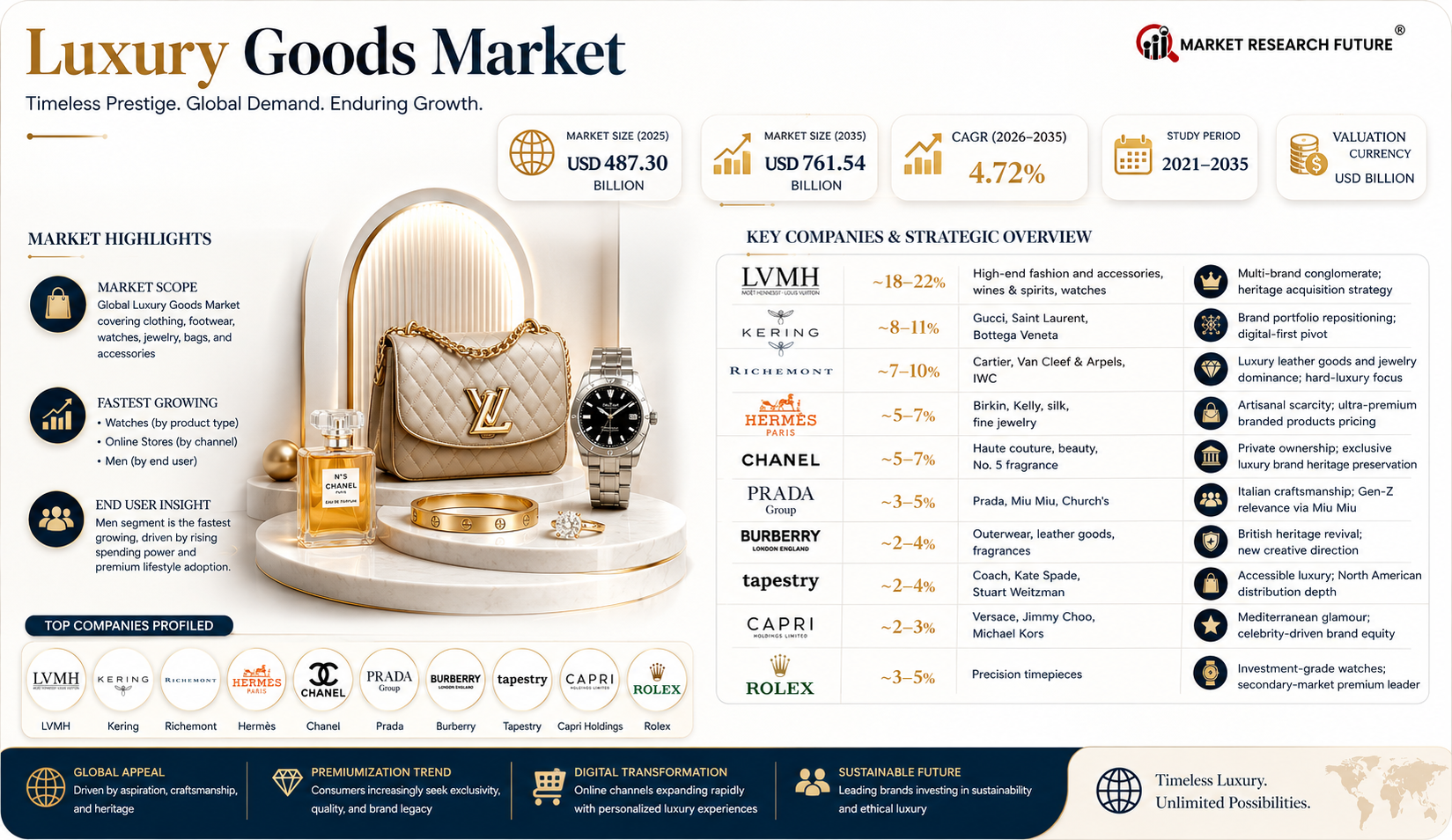

Luxury Goods Market is projected to reach USD 761.54 billion by 2035, driven by digital retail, premiumization, watches and evolving affluent consumers.
NEW YORK, NY, UNITED STATES, August 25, 2026 /EINPresswire.com/ —
The global Luxury Goods Market is entering a period of structural evolution as consumers increasingly combine traditional luxury values—craftsmanship, exclusivity, heritage and brand prestige—with digital convenience, personalization and sustainability. The market, covering clothing, footwear, watches, jewelry, bags and accessories, is projected to expand from USD 487.30 billion in 2025 to USD 761.54 billion by 2035, representing a 4.72% CAGR from 2026 to 2035. The study period spans 2021–2035, with valuation expressed in USD billion.
A major driving factor is the transformation of luxury consumption from purely ownership-oriented purchasing toward experiences, cultural relevance, investment value and digitally enabled discovery. Affluent consumers increasingly expect brands to provide seamless interactions across boutiques, websites, social platforms and personalized clienteling. At the same time, younger buyers are influencing product design, communication and purchasing behavior, creating opportunities for brands that can combine heritage with contemporary relevance.
Competitive Landscape and Key Players
The competitive environment remains highly concentrated around globally recognized luxury houses with substantial brand equity, proprietary distribution networks and strong pricing power. LVMH Moët Hennessy Louis Vuitton maintains the broadest portfolio, with an estimated 18–22% revenue share range, supported by high-end fashion and accessories, wines and spirits, and watches. Its multi-brand conglomerate model enables cross-category exposure and a heritage-led acquisition strategy.
Kering SA, estimated at 8–11%, competes through Gucci, Saint Laurent and Bottega Veneta, with emphasis on portfolio repositioning and digital transformation. Compagnie Financière Richemont, at approximately 7–10%, benefits from Cartier, Van Cleef & Arpels and IWC, giving it a strong position in jewelry and hard luxury. Hermès International holds an estimated 5–7%, supported by artisanal scarcity, controlled production and ultra-premium pricing.
Chanel S.A. also represents approximately 5–7%, relying on haute couture, beauty and iconic fragrance franchises while preserving private ownership and brand exclusivity. Prada Group, at roughly 3–5%, combines Italian craftsmanship with growing relevance among younger consumers through Prada and Miu Miu. Rolex SA, estimated at 3–5%, occupies a distinctive position in precision timepieces and investment-oriented luxury watches. Other important competitors include Burberry Group, Tapestry Inc. and Capri Holdings, each leveraging heritage, accessible luxury, celebrity influence or regional distribution capabilities.
Free Sample Copy – Access A Complimentary Copy of Our Report to Explore Its Content and Insights
https://www.marketresearchfuture.com/sample_request/11629
Market Segmentation Analysis
Clothing
Luxury clothing remains a foundational product category, encompassing haute couture, ready-to-wear, outerwear and designer collections. Demand is shaped by brand heritage, seasonal collections, celebrity influence and craftsmanship. Luxury apparel is also becoming increasingly connected to cultural identity, with consumers seeking products that communicate individuality rather than simply displaying logos. Brands are therefore balancing recognizable signatures with quieter, craftsmanship-led designs.
Footwear
Luxury footwear benefits from its combination of fashion appeal, functionality and relatively accessible entry pricing compared with high-value handbags, jewelry or watches. Sneakers, designer heels, boots and formal footwear are attracting diverse consumer groups. Collaborations, limited editions and creative reinterpretations of classic silhouettes continue to support desirability. Digital channels are particularly important for footwear discovery because consumers frequently research collections online before purchasing.
Watches
Watches are identified as the fastest-growing segment by product type. Luxury timepieces occupy a unique position because they combine craftsmanship, heritage, engineering and perceived investment value. Mechanical watches continue to attract collectors, while younger consumers are entering the category through fashion-led models and digitally influenced purchasing journeys. The secondary market also strengthens the investment narrative around prestigious watches. Recent industry developments indicate increasing regional divergence, with U.S. demand becoming particularly important for Swiss luxury watches in 2026.
Jewelry
Luxury jewelry is supported by demand for fine craftsmanship, precious materials, gifting and wealth preservation. Consumers increasingly value provenance, design narratives and personalization. High jewelry collections also allow established houses to reinforce scarcity and exclusivity through limited production. Digital discovery is expanding, although high-value transactions continue to depend heavily on trust, authentication and personalized service.
Bags
Luxury bags remain one of the most recognizable expressions of brand identity. Iconic silhouettes from established houses can generate sustained demand because of their association with heritage, craftsmanship and social status. The category is also being reshaped by changing consumer preferences around functionality, gender-neutral styling and resale value. Men’s adoption of designer bags is expanding the addressable customer base and supporting broader product diversification.
Accessories
Accessories—including belts, scarves, sunglasses, small leather goods and other fashion complements—provide luxury houses with opportunities to increase customer frequency and attract consumers at different price points. Small leather goods and accessories can serve as entry products for first-time luxury buyers, while limited editions and collaborations generate additional engagement.
Distribution Channel
Online stores are projected to be the fastest-growing channel. Luxury e-commerce has evolved beyond simple transactional retail toward appointment booking, virtual clienteling, personalization and digitally assisted discovery. Brands are increasingly integrating online and physical stores so that customers can move seamlessly between channels. Kering, for example, has emphasized integrated e-commerce and physical retail as part of its digital operating model.
Physical boutiques nevertheless remain essential because luxury purchasing often depends on tactile product interaction, expert service and controlled brand environments. The future distribution model is therefore likely to be omnichannel rather than purely digital.
End User
Men represent the fastest-growing end-user segment, reflecting broader changes in men’s fashion consumption, increased interest in designer accessories, premium watches and luxury footwear. Men’s luxury is expanding beyond traditional watches and formalwear toward bags, jewelry, sneakers and fashion accessories. At the same time, women remain a major consumer base across handbags, clothing, jewelry, footwear and beauty-related luxury categories.
Key Growth Drivers
Several forces are expected to support the market through 2035. Rising disposable income among affluent populations, expansion of high-net-worth consumer groups, international tourism, premiumization and stronger digital penetration are important structural factors. Luxury brands are also investing in experiential retail, storytelling and cultural collaborations to maintain relevance among younger customers.
Another important driver is the growing importance of sustainability and circularity. Consumers increasingly evaluate material sourcing, product longevity, repairability and resale potential alongside aesthetics. This is pushing luxury companies to reconsider supply chains, material innovation and product life cycles.
Proceed To Buy – Move Forward with Your Purchase and Gain Instant Access to the Complete Report
https://www.marketresearchfuture.com/checkout?currency=one_user-USD&report_id=11629
Industry Development
Kering Accelerates Its “Next Luxury” Strategy
In April 2026, Kering introduced its ReconKering strategic framework, emphasizing renewed desirability, operational discipline, technology, client intelligence and new categories. The strategy includes the use of AI, cloud-native systems and digital technologies to strengthen client engagement and operational decision-making.
The development reflects a broader industry transition in which luxury companies are using technology not merely for e-commerce, but also for demand forecasting, personalization, clienteling, product development and operational efficiency.
Sustainability Moves Toward Circular Luxury
Sustainability is increasingly becoming embedded within luxury operating models rather than functioning solely as a marketing initiative. Kering’s 2026 strategy emphasizes resource efficiency, craftsmanship and material innovation, alongside services such as repair and certified resale.
Similarly, Louis Vuitton’s Regeneration 2030 roadmap focuses on eco-design, circular creativity and sustainable operations, including reuse and recycling initiatives. These developments indicate that circularity, traceability and alternative materials are becoming strategic components of long-term luxury competitiveness.
Future Outlook
The Luxury Goods Market is expected to remain resilient through 2035, but growth will increasingly depend on how effectively brands manage the tension between exclusivity and accessibility. Excessive price increases can challenge aspirational demand, while excessive discounting can weaken scarcity and brand equity. Consequently, companies are likely to emphasize carefully structured product portfolios, entry-level offerings, limited editions and high-value flagship products.
The strongest opportunities are expected to emerge where heritage is combined with innovation. Watches are positioned for strong growth because of their collectible and investment characteristics, while online stores are gaining importance as luxury consumers become more comfortable with digitally assisted purchasing. Men’s luxury is also broadening beyond conventional categories.
Ultimately, the market’s projected rise to USD 761.54 billion by 2035 reflects more than increasing luxury consumption. It represents the industry’s transition toward digitally connected, culturally relevant, technologically enabled and increasingly circular luxury. Companies capable of protecting craftsmanship and exclusivity while responding to changing consumer expectations are likely to be best positioned for sustained growth at a 4.72% CAGR through 2035.
Frequently Asked Questions
1. What will be the size of the Luxury Goods Market by 2035?
The global Luxury Goods Market is projected to reach USD 761.54 billion by 2035, compared with USD 487.30 billion in 2025, reflecting a 4.72% CAGR during 2026–2035.
2. Which segment is expected to grow fastest in the Luxury Goods Market?
Watches are projected to be the fastest-growing product segment, while Online Stores are expected to be the fastest-growing distribution channel and Men the fastest-growing end-user segment.
Read Our Related Research Report
Luxury Jewelry Market –
https://www.marketresearchfuture.com/reports/luxury-jewelry-market-6992
Luxury Handbags Market –
https://www.marketresearchfuture.com/reports/luxury-handbags-market-7922
Luxury Fashion Market –
https://www.marketresearchfuture.com/reports/luxury-fashion-market-1770
Luxury Apparel Market –
https://www.marketresearchfuture.com/reports/luxury-apparel-market-11938
Sagar Kadam
Market Research Future
+1 628-258-0071
email us here
Legal Disclaimer:
EIN Presswire provides this news content “as is” without warranty of any kind. We do not accept any responsibility or liability
for the accuracy, content, images, videos, licenses, completeness, legality, or reliability of the information contained in this
article. If you have any complaints or copyright issues related to this article, kindly contact the author above.

Media gallery


