
Audio Amplifier Market Size to Hit USD 7.06 Billion by 2035 with a 4.95% CAGR
Audio Amplifiers Market Size, Share and Research Report By Channel Configuration (2-Channel, 4-Channel, 6-Channel,
Press Release Disclaimer: This is a press release distributed through the XPR Media network. It has not been independently verified by our newsroom.
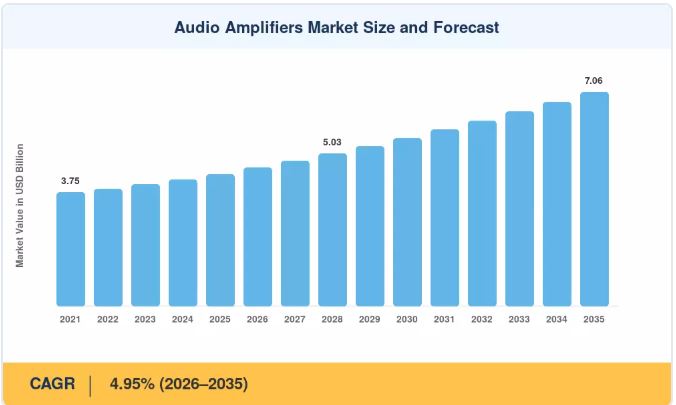

Audio Amplifiers Market Size, Share and Research Report By Channel Configuration (2-Channel, 4-Channel, 6-Channel, 8-Channel and Above), By Device Integration
NEW YORK,, NY, UNITED STATES, August 25, 2026 /EINPresswire.com/ — The Global Audio Amplifier market reached a valuation of USD 4.35 billion in 2025 and is projected to grow from USD 4.57 billion in 2026 to USD 7.06 billion by 2035, registering a CAGR of 4.95% across the forecast window. Two structural forces are anchoring this expansion: the global pivot to electric mobility, where quieter EV cabins demand premium multi-channel audio, and the proliferation of immersive home-entertainment ecosystems driven by Dolby Atmos and spatial-audio standards.
According to the Consumer Technology Association, U.S. consumer spending on home audio equipment surpassed USD 9.2 billion in 2024, reflecting a durable appetite for high-performance sound. The market’s 4.95% CAGR reflects the convergence of EV cabin audio proliferation (+0.95% impact), GaN power-stage adoption (+0.80%), immersive home-theater and spatial audio (+0.70%), and TWS earbuds and wearable audio growth (+0.55%) accelerating across the world’s largest automotive and consumer-electronics economies simultaneously.
A technology inflection is reshaping the audio amplifier market from the substrate level upward. Legacy linear amplifiers and early-generation Class-AB designs are ceding ground to Class-D topologies that deliver conversion efficiencies above 90%. Gallium-nitride power stages are accelerating this transition by shrinking heat-sink requirements and enabling form factors previously impractical for high-wattage applications. The European Commission’s Ecodesign Directive for electronic displays and audio equipment, updated in 2024, imposes idle-power ceilings that favor high-efficiency digital amplification architectures. Asia-Pacific commands roughly 51.2% of the market, led by China’s semiconductor fabrication capacity and Japan’s consumer-electronics heritage.
Get Full PDF Sample Copy of Report: (Including Full TOC, List of Tables & Figures, Chart) @
https://www.marketresearchfuture.com/sample_request/10088
➤ How Significant Is the Audio Amplifier Market’s Growth?
The audio amplifier market’s trajectory from USD 4.35 billion in 2025 to a projected USD 7.06 billion by 2035 represents a steady, technology-anchored expansion over the forecast decade, reflecting the structural shift from linear and Class-AB designs toward Class-D, gallium-nitride-based architectures embedded across automotive, consumer electronics, and professional audio applications. The market’s 4.95% CAGR is anchored in an electrification-and-immersive-audio supercycle where EV cabin acoustics, spatial-audio content pipelines, and wearable device miniaturization are all converging to sustain durable, multi-decade demand for high-efficiency amplification silicon.
2-channel amplifier models captured 44.5% revenue share of the market in 2025, driven by stereo applications across headphones, portable speakers, and entry-level home systems, while integrated audio system-on-chip platforms are recording the fastest segment CAGR at 6.45% through 2035 as OEMs prioritize single-die solutions for wearables and true wireless stereo earbuds. Stand-alone amplifier ICs held 58.3% of the market in 2025, reflecting their dominance in discrete hi-fi and professional audio chains. Silicon-based devices retained 86.3% revenue share in 2025, though GaN amplifiers are growing at a 7.70% CAGR as thermal efficiency becomes a design priority. Consumer electronics contributed 62.4% of the market in 2025, spanning smartphones, smart speakers, soundbars, and gaming peripherals, while automotive audio deployments, particularly in battery-electric vehicles, are advancing at a 5.60% CAGR through 2035.
➤ What Does the Future Hold for the Audio Amplifier Market?
Electric-vehicle cabin audio proliferation contributes approximately +0.95 percentage points to the audio amplifier market’s CAGR the single highest driver impact. Battery-electric vehicles eliminate internal-combustion noise, creating a cabin environment where audio quality becomes a tangible brand differentiator. BMW’s collaboration with Bowers & Wilkins, for instance, specifies four-channel Class-D amplifiers delivering over 1,400 watts per vehicle, a configuration that was cost-prohibitive in ICE platforms. BloombergNEF projects global EV sales will exceed 30 million units annually by 2028, each representing an incremental amplifier attach opportunity for the market.
GaN power-stage adoption contributes approximately +0.80 percentage points to the CAGR, establishing wide-bandgap semiconductor migration as a primary structural driver. Gallium-nitride transistors operate at switching frequencies above 1 MHz, enabling output filters that are significantly smaller than silicon MOSFET equivalents. EPC (Efficient Power Conversion) reported a 28% year-over-year increase in GaN audio-amplifier design wins during 2024, and the U.S. Department of Energy’s Wide-Bandgap Semiconductor Initiative has allocated USD 45 million toward domestic GaN epitaxy R&D through 2027.
Immersive home-theater and spatial audio adds a further +0.70% as Dolby Atmos-enabled content on streaming platforms grew 65% between 2022 and 2024, pulling consumers toward multi-channel AV receivers and powered soundbars that embed discrete amplifier stages for height channels, while TWS earbuds and wearable audio growth contribute a further +0.55% as global TWS shipments reached 380 million units in 2024, with active noise cancellation becoming standard even in sub-USD 50 price tiers.
Get access to the full description of the report @
https://www.marketresearchfuture.com/reports/audio-amplifiers-market-10088
➤ Who Are the Key Players in the Audio Amplifier Market?
The audio amplifier market exhibits medium concentration, with an estimated top-five revenue share of 48–55% and a Herfindahl-Hirschman Index in the 900–1,100 range. Texas Instruments and STMicroelectronics occupy clear leadership positions through broad analog portfolios, while specialist players such as Cirrus Logic and Qualcomm compete on integration density and codec performance. Industry consolidation, including HARMAN’s acquisition of Sound United and Bose’s purchase of McIntosh Group, signals that scale and brand breadth are becoming strategic imperatives. MRFR identifies the following key participants with estimated revenue share ranges:
★ Texas Instruments (~13–17% share)
★ STMicroelectronics (~9–13% share)
★ Analog Devices (~7–10% share)
★ NXP Semiconductors (~6–9% share)
★ Cirrus Logic (~5–8% share)
★ Infineon Technologies (~4–7% share)
★ Qualcomm (~4–6% share)
★ onsemi (~3–5% share)
★ ROHM Semiconductor (~3–5% share)
★ Realtek Semiconductor (~2–4% share)
Strategic competition in the audio amplifier market is increasingly defined by wide-bandgap semiconductor integration and platform-level DSP-NPU convergence with gallium raw-material supply concentration cited as a top structural headwind, contributing an estimated -0.45% drag on CAGR as China processes around 80% of the world’s gallium and its 2023 export-licensing limits drove spot-price hikes beyond 40% in a single quarter, alongside semiconductor capital-expenditure cyclicality that extended lead times for 180nm and 130nm analog processes beyond 40 weeks during the 2022–2023 shortage cycle, consumer discretionary spending softness, and regulatory divergence on e-waste recycling across Europe and South America.
➤ What Are the Emerging Trends in the Audio Amplifier Market?
Several transformational trends are redefining the audio amplifier market’s evolution through 2035:
Automotive Zone-Amplifier Architectures: Next-generation vehicle electrical/electronic systems are shifting from point-to-point wiring toward zonal controllers that combine amplification into two or three high-power nodes, offering a replacement cycle for older head-unit amplifiers worth an incremental USD 1.2 billion by 2032.
Edge-AI Adaptive Amplification: On-device neural networks can analyze room acoustics in real time and adjust amplifier gain, equalization, and crossover points without cloud latency, with Apple’s Adaptive Audio feature in AirPods Pro demonstrating strong consumer appetite for intelligent sound processing.
Emerging-Market Venue and Hospitality Build-Out: Saudi Arabia’s Vision 2030 program has earmarked over USD 800 billion for entertainment, tourism, and cultural infrastructure, with professional audio systems specified for stadiums, theme parks, and mega-hotels, while India’s live-events industry is expanding at 15% annually.
Amplifier-as-a-Service and Subscription Audio: Sonos, HARMAN, and several startups are experimenting with subscription models bundling amplifier hardware with streaming, room-calibration software, and over-the-air firmware upgrades, improving vendor lifetime value by an estimated 35–50% versus one-time hardware sales.
Recycled-Substrate and Circular-Economy Initiatives: Substrate-recycling programs for GaN and SiC wafers, pioneered by Soitec and II-VI (now Coherent), could reduce raw-material dependency on China by up to 20% by 2030, positioning early-moving vendors for both cost advantages and ESG credibility.
Buy Full Research Report:
https://www.marketresearchfuture.com/checkout?currency=one_user-USD&report_id=10088
➤ How Is the Audio Amplifier Market Segmented?
The audio amplifier market report provides a comprehensive segmentation framework:
By Channel Configuration: 2-Channel (44.5% share, 2025), 4-Channel (USD 0.78 billion, 2025), 6-Channel (5.30% CAGR), 8-Channel and Above (6.15% CAGR)
By Device Integration / Form Factor: Stand-Alone Audio-Amplifier IC (58.3% share, 2025), Integrated Audio SoC (6.45% CAGR)
By Semiconductor Material: Silicon (86.3% share, 2025), Gallium Nitride / GaN (7.70% CAGR), Silicon Carbide / SiC (USD 0.04 billion, 2025)
By End-User Application: Consumer Electronics (62.4% share, 2025), Automotive (5.60% CAGR), Professional Audio (USD 0.38 billion, 2025), Industrial & Other (4.10% CAGR)
By Region: Asia-Pacific (51.2% share, 2025), North America (USD 1.02 billion, 2025), Europe (4.80% CAGR), South America (USD 0.17 billion, 2025), Middle East & Africa (5.40% CAGR)
➤ What Are the Regional Insights from the Audio Amplifier Market?
Asia-Pacific commands 51.2% of the audio amplifier market, exhibiting a pronounced concentration built on semiconductor fabrication clusters in China, Japan, and South Korea underpinning both supply and demand. China holds 54.8% of regional share through semiconductor fabrication and domestic consumer-electronics brands, India is posting a 6.10% CAGR within the region through urbanization, live-events growth, and smartphone penetration exceeding 750 million users, Japan contributed USD 0.27 billion through its hi-fi audio heritage and automotive Tier-1 supplier base, South Korea holds 9.5% of regional share through Samsung and LG consumer-electronics ecosystems, and ASEAN is growing at a 5.85% CAGR through contract manufacturing and rising middle-class consumption.
North America retains the second-largest share of the audio amplifier market at USD 1.02 billion in 2025, with the United States commanding 78.5% of regional share through automotive OEM audio programs and home-theater upgrades, as automakers including General Motors and Ford specify premium audio packages as standard equipment in EV lineups. The Inflation Reduction Act’s domestic-content incentives also encourage U.S.-based amplifier IC packaging and test operations, giving the market a policy tailwind through at least 2030. Canada is growing at a 4.65% CAGR through professional AV installations and live-entertainment venues, and Mexico contributed USD 0.05 billion through contract electronics manufacturing for export.
Europe’s growth in the audio amplifier market is tightly linked to the EV transition, with the European Commission’s 2035 ICE phase-out deadline ensuring every new passenger vehicle sold in the EU will carry an electric powertrain and, with it, amplifier systems optimized for low-noise cabins. Germany commands 26.4% of regional share through automotive premium audio at BMW, Mercedes-Benz, and Audi, the United Kingdom is growing at a 4.70% CAGR through professional broadcast and live-sound sectors, France contributed USD 0.09 billion through consumer hi-fi heritage and smart-home adoption, Italy holds 8.2% of regional share through luxury automotive and pro-audio manufacturing, Spain is posting a 4.55% CAGR through hospitality and tourism AV installations, the Nordic countries contributed USD 0.05 billion through high per-capita spending on premium audio, and Russia holds 5.1% of regional share through domestic consumer-electronics substitution.
South America and the Middle East & Africa round out the audio amplifier market’s regional footprint, with the latter posting the fastest growth of any geography at a 5.40% CAGR. Brazil commands 62.0% of South American revenue through consumer audio and automotive aftermarket demand, benefiting from a large domestic consumer base and an active in-car audio upgrade culture, though currency volatility and import tariffs on semiconductor components limit penetration in this price-sensitive market
➤➤➤ Industry Analysis Reports by Market Research Future:
Cable Assembly Market
https://www.marketresearchfuture.com/reports/cable-assembly-market-29052
Diamond Substrate Market
https://www.marketresearchfuture.com/reports/diamond-substrate-market-34427
Gold Loan Market
https://www.marketresearchfuture.com/reports/gold-loan-market-24606
Insurance Bpo Services Industry Market
https://www.marketresearchfuture.com/reports/insurance-bpo-services-industry-market-24181
Leasing Market
https://www.marketresearchfuture.com/reports/leasing-market-24472
Litigation Funding Investment Market
https://www.marketresearchfuture.com/reports/litigation-funding-investment-market-22886
Payday Loans Market
https://www.marketresearchfuture.com/reports/payday-loans-market-24681
Tax Advisory Services Market https://www.marketresearchfuture.com/reports/tax-advisory-services-market-24697
Trade Finance Market
https://www.marketresearchfuture.com/reports/trade-finance-market-24698
Wealthtech Solutions Market
https://www.marketresearchfuture.com/reports/wealthtech-solutions-market-24442
Market Research Future
Market Research Future
+16282580071 ext.
email us here
Legal Disclaimer:
EIN Presswire provides this news content “as is” without warranty of any kind. We do not accept any responsibility or liability
for the accuracy, content, images, videos, licenses, completeness, legality, or reliability of the information contained in this
article. If you have any complaints or copyright issues related to this article, kindly contact the author above.

Media gallery


