BFSI Security Market Expected to Achieve USD 267.3 Billion by 2035 Through Robust 12.1% CAGR
BFSI Security Market Size, Share & Research Report By Security Type (Information Security, Physical Security), By
Press Release Disclaimer: This is a press release distributed through the XPR Media network. It has not been independently verified by our newsroom.

BFSI Security Market Size, Share & Research Report By Security Type (Information Security, Physical Security), By Services Type (System Integration, Maintenance
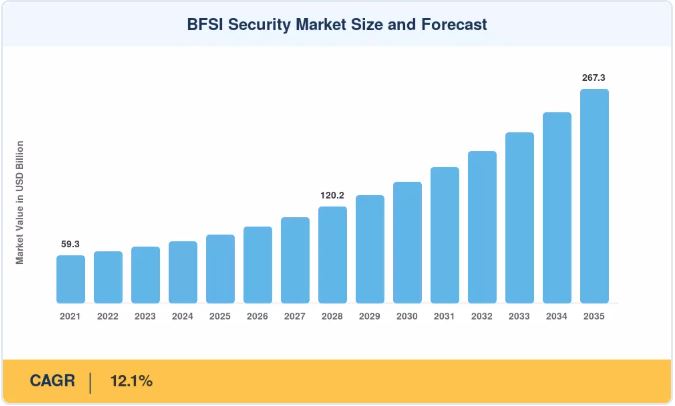
NEW YORK,, NY, UNITED STATES, August 25, 2026 /EINPresswire.com/ — The Global BFSI Security market reached an estimated USD 85.2 billion in 2025 and is projected to grow from USD 95.6 billion in 2026 to USD 267.3 billion by 2035, registering a CAGR of 12.1% across the forecast window. Two forces are accelerating this trajectory: a global wave of regulatory mandates, from the EU’s Digital Operational Resilience Act (DORA) to the U.S. Gramm-Leach-Bliley Act enforcement updates, and a surge in sophisticated cyberattacks targeting financial institutions.
The World Bank estimates that financial-sector cyberattack costs surpassed USD 12 billion globally in 2024, making security investment a board-level priority rather than an IT line item. The market’s 12.1% CAGR reflects the convergence of rising frequency and cost of financial cyberattacks (~18% impact), regulatory compliance mandates (~17%), cloud migration and hybrid-infrastructure security (~16%), and AI and ML integration in threat detection (~15%) accelerating across the world’s largest banking and regulatory-compliance economies simultaneously.
Legacy perimeter-based defenses are giving way to zero-trust architectures, AI-driven threat detection platforms, and cloud-native security stacks. Large banks in North America and Europe alone committed more than USD 35 billion to cybersecurity transformation programs between 2022 and 2024, according to Accenture and IBM Security research. Physical security, encompassing video surveillance, access control, and intrusion detection at branches, ATMs, and data centers, remains a parallel spending stream, though digital threats now dominate incremental budgets.
North America commands roughly 38% of the market, anchored by stringent compliance frameworks and high digital-banking penetration. Asia-Pacific is the fastest-growing region with an estimated CAGR of 14.5%, propelled by rapid fintech adoption in India, China, and Southeast Asia. Europe holds the second-largest share at approximately 27%, driven by DORA and PSD2 mandates. Over the next decade, convergence of information security and physical security platforms will reshape competitive dynamics across all regions.
Get Full PDF Sample Copy of Report: (Including Full TOC, List of Tables & Figures, Chart) @
https://www.marketresearchfuture.com/sample_request/1810
➤ How Significant Is the BFSI Security Market’s Growth?
The BFSI security market’s trajectory from USD 85.2 billion in 2025 to a projected USD 267.3 billion by 2035 represents more than a three-fold expansion over the forecast decade, reflecting the structural shift from perimeter-based defenses toward zero-trust, AI-driven, and cloud-native security architectures deployed across banking, insurance, and capital-markets institutions. The market’s 12.1% CAGR is anchored in a compliance-and-threat supercycle where regulatory mandates, escalating cyberattack costs, and cloud infrastructure migration are all converging to make security investment a board-level, non-discretionary priority rather than a routine IT expenditure.
Information Security holds the dominant share of the market at approximately 68% in 2025, underpinned by endpoint protection, identity management, and encryption spending, while Physical Security is forecast to grow at a CAGR of 10.3%, reflecting branch modernization and smart-surveillance rollouts across emerging economies. Cloud-Based deployment captured roughly USD 38.4 billion in 2025 as institutions migrate workloads to hybrid-cloud environments, while On-Premises solutions still account for a 52% share of the market, favored by large banks subject to data-sovereignty regulations. By vertical, Banking commands approximately 61% of the market, reflecting high transaction volumes and regulatory scrutiny, while Insurance is the faster-growing vertical at a 13.4% CAGR, propelled by the digitalization of underwriting, claims, and distribution channels.
➤ What Does the Future Hold for the BFSI Security Market?
Rising frequency and cost of financial cyberattacks contributes approximately 18% of driver impact to the BFSI security market’s growth the single highest driver impact. IBM’s 2024 Cost of a Data Breach Report pegged the average financial-sector breach cost at USD 6.08 million, the second-highest of any industry. Ransomware incidents targeting banks grew 64% between 2022 and 2024 according to FS-ISAC data, compelling CISOs to double endpoint-detection and response budgets, a threat escalation that makes the market one of the most resilient enterprise-security verticals.
Regulatory compliance mandates contribute approximately 17% of driver impact, establishing compliance-driven spending as a primary structural demand source. DORA, effective January 2025, requires all EU financial entities to implement ICT risk-management frameworks, conduct threat-led penetration testing, and report major incidents within four hours. In the United States, the FFIEC updated its Cybersecurity Assessment Tool in 2024, tightening expectations for community banks with assets below USD 10 billion. These parallel mandates create a compliance-driven spending floor that insulates the market from discretionary budget cuts. Cloud migration and hybrid-infrastructure security adds a further 16% of impact as an estimated 65% of banking workloads will run in public or hybrid clouds by 2027, up from 38% in 2023, with each migration triggering spending on cloud-access security brokers, cloud workload protection platforms, and secure-access service edge architectures.
The next phase of the market’s evolution centers on AI-autonomous security operations, with 75% of large banks projected to operate AI-autonomous SOCs capable of end-to-end triage, investigation, and remediation with minimal human intervention by 2030 self-healing security environments that will shift vendor competition from point-product performance to orchestration-platform intelligence. Unified command centers integrating video analytics, access control, transaction monitoring, and cyber-threat feeds into a single pane of glass are moving from concept to production, with Johnson Controls and Honeywell each announcing converged-security platforms tailored for bank branches and data centers.
The Financial Stability Board’s 2024 recommendations on cyber-incident reporting aim to harmonize disclosure timelines across G20 jurisdictions, favoring large, globally integrated vendors, while self-sovereign identity wallets and verifiable credentials are expected to handle 20% of customer-authentication events at major banks by 2032, and the migration to quantum-safe cryptographic algorithms will require institutions to audit and replace billions of encryption keys.
Get access to the full description of the report @
https://www.marketresearchfuture.com/reports/bfsi-security-market-1810
➤ Who Are the Key Players in the BFSI Security Market?
The BFSI security market exhibits medium concentration, with the top five vendors collectively holding an estimated 28–34% revenue share. The Herfindahl-Hirschman Index sits in the low-to-moderate range of approximately 650–800, reflecting a fragmented tail of specialized niche players alongside a handful of full-stack platform vendors. Competition centers on platform breadth, AI/ML detection efficacy, and the ability to bundle compliance-reporting capabilities. MRFR identifies the following key participants with estimated revenue share ranges:
IBM Corporation (~6–9% share) – a full-stack security provider with a consulting arm offering QRadar SIEM, Guardium, and X-Force Threat Intelligence, having launched Guardium Quantum Safe in March 2025, a data-protection suite enabling banks to inventory and migrate cryptographic assets ahead of quantum-computing threats.
Cisco Systems (~5–8% share) – a network-centric security platform leader offering SecureX, Duo, Umbrella, and Talos Intelligence, anchoring identity and network-access security across large financial-institution deployments.
Broadcom Inc. / Symantec (~4–7% share) – an enterprise endpoint and data-protection specialist offering Symantec Endpoint, DLP, and CloudSOC, serving customers requiring mature data-loss-prevention capabilities across hybrid environments.
Palo Alto Networks (~4–7% share) – a cloud-native and AI-first platform provider offering Prisma Cloud, Cortex XDR, and XSIAM, positioned at the forefront of AI-augmented security operations center transformation.
Fortinet (~3–6% share) – a unified threat management specialist with ASIC-accelerated performance offering FortiGate, FortiSIEM, and FortiEDR, serving customers requiring high-throughput network security appliances.
Check Point Software (~3–5% share) – a consolidated prevention-first platform provider offering Infinity Architecture, CloudGuard, and Harmony, emphasizing threat prevention over detection-and-response as its core differentiator.
Trend Micro (~2–4% share) – a hybrid-cloud workload protection specialist offering Vision One, Cloud One, and Deep Security, serving institutions managing complex multi-cloud banking infrastructure.
Honeywell International (~2–4% share) – a physical-security convergence leader offering Pro-Watch, MAXPRO Cloud, and building automation, positioned at the intersection of physical and cyber security platforms for bank branches.
Johnson Controls International (~2–3% share) – an integrated physical security systems provider offering Tyco, C-CURE, and exacqVision, serving customers requiring unified access control and video surveillance across branch networks.
CrowdStrike Holdings (~2–4% share) – a cloud-delivered EDR and XDR pioneer offering the Falcon platform, Charlotte AI, and LogScale, having expanded the Falcon platform with Charlotte AI for financial-services SOCs in May 2023, reducing mean-time-to-respond by an estimated 35% in pilot deployments.
Strategic competition in the BFSI security market is increasingly defined by AI/ML detection efficacy and the ability to bundle compliance-reporting capabilities with a skilled cybersecurity workforce shortage cited as a top structural headwind, contributing an estimated -2.8% drag on CAGR as ISC2’s 2024 Cybersecurity Workforce Study identified a global shortfall of 3.4 million security professionals, with financial services accounting for an estimated 12% of unfilled roles, alongside high total cost of ownership for legacy integration, data-sovereignty and cross-border compliance friction, vendor lock-in and interoperability challenges, and budget constraints among smaller financial institutions.
➤ What Are the Emerging Trends in the BFSI Security Market?
Several transformational trends are redefining the BFSI security market’s evolution through 2035:
Rising Frequency and Cost of Financial Cyberattacks: IBM’s 2024 Cost of a Data Breach Report pegged the average financial-sector breach cost at USD 6.08 million, while ransomware incidents targeting banks grew 64% between 2022 and 2024, compelling CISOs to double endpoint-detection and response budgets.
Regulatory Compliance Mandates: DORA, effective January 2025, requires all EU financial entities to implement ICT risk-management frameworks and report major incidents within four hours, while the FFIEC’s updated Cybersecurity Assessment Tool tightens expectations for community banks under USD 10 billion in assets.
AI-Powered Fraud Analytics Platforms: Banks processing over a billion transactions daily require sub-second decisioning, with unified fraud-analytics suites incorporating behavioral biometrics, device fingerprinting, and graph-network analysis attracting greenfield demand from digital-only neobanks across Southeast Asia and Latin America.
Quantum-Safe Cryptography Migration: NIST released its first post-quantum cryptography guidelines in 2024, with central banks including the ECB and Monetary Authority of Singapore recommending proactive migration, positioning early movers with crypto-agility solutions for premium pricing as regulatory deadlines loom.
Convergence of Physical and Cyber Security Platforms: Unified command centers integrating video analytics, access control, transaction monitoring, and cyber-threat feeds into a single pane of glass are moving from concept to production, with Johnson Controls and Honeywell each announcing converged-security platforms for bank branches and data centers.
Buy Full Research Report:
https://www.marketresearchfuture.com/checkout?currency=one_user-USD&report_id=1810
➤ How Is the BFSI Security Market Segmented?
The BFSI security market report provides a comprehensive segmentation framework:
By Security Type: Information Security (~68% share, 2025), Physical Security (10.3% CAGR)
By Services Type: System Integration (USD 28.5 billion, 2025), Maintenance (~34% share, 2025), Support (13.1% CAGR)
By Deployment Model: On-Premises (~52% share, 2025), Cloud-Based (14.8% CAGR)
By Vertical: Banking (~61% share, 2025), Insurance (13.4% CAGR)
By Region: North America (~38% share, 2025), Europe (~27% share, 2025), Asia-Pacific (14.5% CAGR), South America (USD 6.0 billion, 2025), Middle East & Africa (13.0% CAGR)
➤ What Are the Regional Insights from the BFSI Security Market?
North America commands roughly 38% of the BFSI security market, generating over USD 32 billion in 2025 revenue, with the United States commanding approximately 79% of regional share as JPMorgan Chase alone disclosed USD 700 million in annual cybersecurity spend in 2024. Canada is growing at an 11.8% CAGR within the region as OSFI Guideline B-13, effective in 2024, mandates technology-risk self-assessments for all federally regulated financial institutions, creating a compliance-pull dynamic, and Mexico contributed USD 1.4 billion as its 2018 Fintech Law is now backed by secondary cybersecurity regulations from the CNBV, gradually formalizing security requirements for the country’s fast-growing digital-lending segment.
Europe holds approximately 27% of global BFSI security market share, with DORA’s January 2025 enforcement date creating a compliance supercycle across the EU, mandating ICT incident reporting, third-party risk management, and digital-resilience testing for banks, insurers, and investment firms. Germany commands roughly 22% of regional share through BaFin’s BAIT/VAIT frameworks, the United Kingdom is growing at an 11.4% CAGR through FCA operational-resilience rules that mirror DORA’s intent despite being outside the EU, France contributed USD 3.5 billion through ANSSI directives and open-banking rollout, Italy is posting an 11.9% CAGR through digital-payments growth and Banca d’Italia guidance, Spain holds 7% of regional share through CaixaBank and BBVA digital transformation, the Nordic countries contributed USD 2.1 billion through high digital-banking penetration, Russia is growing at a 9.8% CAGR through Central Bank of Russia cyber-regulation, and the rest of Europe holds 12% of regional share through DORA harmonization across the EU-27.
Asia-Pacific is the fastest-growing contributor to the BFSI security market at an estimated 14.5% CAGR, driven by an explosion in digital-payment volumes and regulatory catch-up. China commands roughly 31% of regional share through PBOC data-security standards and digital-yuan infrastructure, India is posting a 16.2% CAGR within the region through the RBI’s IT governance framework and UPI growth, which completed 13.4 billion transactions in a single month in late 2024, Japan contributed USD 3.8 billion through FSA cybersecurity guidelines and mega-bank spend, South Korea is growing at a 13.5% CAGR through KISA mandates and K-banking digital expansion, ASEAN holds 14% of regional share through mobile-banking adoption and MAS Technology Risk Management guidelines, and the rest of Asia-Pacific is growing at a 12.8% CAGR through fintech proliferation in frontier economies.
South America and the Middle East & Africa round out the BFSI security market’s regional footprint. Brazil commands roughly 62% of South American revenue as its central bank recorded a 467% increase in Pix-related fraud attempts between 2021 and 2024, compelling banks to invest in transaction-monitoring overlays and biometric authentication, while Argentina is growing at a 13.6% CAGR as its rapidly growing fintech sector, now exceeding 300 licensed providers, faces escalating regulatory scrutiny.
In the Middle East & Africa, Saudi Arabia commands roughly 28% of regional share as Vision 2030 channels billions into digital-banking infrastructure, with the Saudi Central Bank requiring all licensed entities to comply with its Cybersecurity Framework by 2025, the UAE is growing at a 14.1% CAGR through DFSA and ADGM cyber-resilience mandates that attract global fintechs to its free zones, South Africa contributed USD 0.9 billion through SARB Directive 3/2023 and mobile-banking fraud prevention, Egypt is posting a 13.7% CAGR through CBE fintech sandbox and digital-payment growth, and the rest of MEA holds 22% of regional share through Islamic digital-banking platforms.
➤➤➤ Regional & Country-Level Reports by Market Research Future:
UK BFSI Security Market –
https://www.marketresearchfuture.com/reports/uk-bfsi-security-market-58979
South Korea BFSI Security Market –
https://www.marketresearchfuture.com/reports/south-korea-bfsi-security-market-58980
Germany BFSI Security Market –
https://www.marketresearchfuture.com/reports/germany-bfsi-security-market-58981
Japan BFSI Security Market –
https://www.marketresearchfuture.com/reports/japan-bfsi-security-market-58982
France BFSI Security Market –
https://www.marketresearchfuture.com/reports/france-bfsi-security-market-58983
India BFSI Security Market –
https://www.marketresearchfuture.com/reports/india-bfsi-security-market-58984
Indonesia BFSI Security Market –
https://www.marketresearchfuture.com/reports/indonesia-bfsi-security-market-58985
Mexico BFSI Security Market –
https://www.marketresearchfuture.com/reports/mexico-bfsi-security-market-58986
Market Research Future
Market Research Future
+16282580071 ext.
email us here
Legal Disclaimer:
EIN Presswire provides this news content “as is” without warranty of any kind. We do not accept any responsibility or liability
for the accuracy, content, images, videos, licenses, completeness, legality, or reliability of the information contained in this
article. If you have any complaints or copyright issues related to this article, kindly contact the author above.

Media gallery