Albany State University Generates $328M Economic Impact, Highest Percentage Increase in University System of Georgia
Albany State University Generated A Record $328 Million Economic Impact In FY 2025, Representing A 16.2% Increase.
Press Release Disclaimer: This is a press release distributed through the XPR Media network. It has not been independently verified by our newsroom.
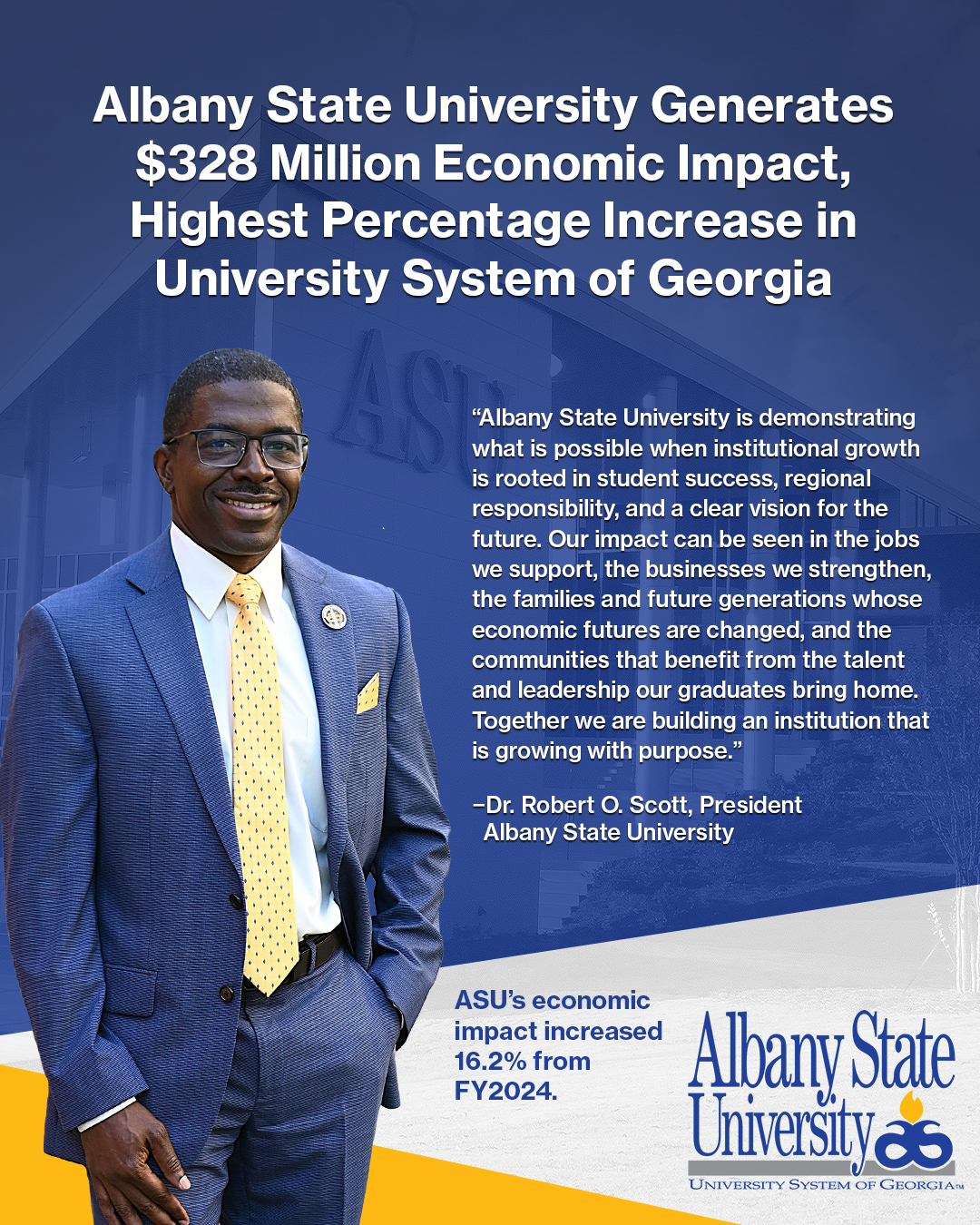

Albany State University Generated A Record $328 Million Economic Impact In FY 2025, Representing A 16.2% Increase.
ALBANY, GA, UNITED STATES, August 17, 2026 /EINPresswire.com/ — Albany State University (ASU) generated an estimated $327,974,095 million in economic impact during Fiscal Year 2025, representing a 16.2% increase over the previous year and the highest percentage increase among institutions in the University System of Georgia (USG), according to the latest USG economic impact report.
The University also supported an estimated 2,826 jobs across its study area, an increase of 160 jobs from FY 2024. This includes Dougherty, Lee, Worth, Mitchell, Terrell, Sumter, Tift, and Crisp counties.
The increase was driven primarily by growth in the economic impact associated with university operating expenditures, along with increases in student spending and personnel-related activity.
ASU Economic Impact: FY 2024 vs. FY 2025
Measure FY 2024 FY 2025 Change
Economic Impact $282.2 million $328.0 million +16.2%
Initial Spending $228.6 million $282.9 million +23.7%
Value Added $189.5 million $212.4 million +12.1%
Labor Income $120.5 million $130.0 million +7.9%
Jobs Supported 2,666 2,826 +160 (+6.0%)
The latest results reflect Albany State’s continued momentum as the University strengthens its role as an economic and educational engine for Southwest Georgia. The University has experienced steady enrollment growth since 2021 that totals 7.8%, accompanied by a renewed institutional focus on retaining students through graduation, and providing the resources and support necessary for their success.
“Albany State University is demonstrating what is possible when institutional growth is rooted in student success, regional responsibility, and a clear vision for the future. Our impact can be seen in the jobs we support, the businesses we strengthen, the families and future generations whose economic futures are changed, and the communities that benefit from the talent and leadership our graduates bring home. Together we are building an institution that is growing with purpose.”
– Dr. Robert O. Scott, President, Albany State University.
Investing in Student Success and Institutional Growth
Under Dr. Scott’s leadership, Albany State has placed significant emphasis on ensuring that enrollment growth translates into student persistence and degree completion. The University’s one-year retention rate has increased steadily since 2020, growing by nearly 12.8 percentage points during that period.
Albany State has expanded investments and programs designed to help students remain enrolled and graduate, including the Presidential Scholarship Program, University College, Summer Success Academy, Study Tables, the HBCU-UP STEM Academy, and other academic and student support initiatives. These efforts reflect the University’s focus on creating a comprehensive pathway from recruitment to retention and, ultimately, graduation.
The University has also expanded its graduate education portfolio to meet emerging workforce and community needs. In the past three years, Albany State has introduced new graduate degree programs in Trauma Psychology, Athletic Training, and Integrated Biotechnology, added a Juvenile Justice concentration to its Criminal Justice graduate program, and launched eight graduate certificates in business and public administration.
These investments come as Albany State continues to see opportunities for further enrollment growth, particularly at the graduate level.
Creating Economic Value Through Education
The economic impact report also illustrates the long-term value Albany State graduates bring to Georgia and the nation. Albany State University conferred 1,439 degrees and certificates in FY 2025, representing an increase of approximately 2.1%. Using synthetic work-life earnings estimates for Georgia, the study projects that ASU’s FY 2025 graduates could generate approximately $4.04 billion in lifetime earnings, with approximately $1.19 billion attributable to their educational attainment.
By degree level:
• Master’s Degrees – 206 graduates; approximately $721.9 million in projected Georgia work-life earnings; $63.5 million attributable to degree attainment
• Bachelor’s Degrees – 627 graduates; approximately $2.00 billion in projected Georgia work-life earnings; $891.6 million attributable to degree attainment
• Associate Degrees – 596 graduates; approximately $1.29 billion in projected Georgia work-life earnings; $231.5 million attributable to degree attainment
• Certificates – 10 graduates; approximately $20.8 million in projected Georgia work-life earnings; $3.1 million attributable to the credential
According to the USG report, “Work-life earnings increase with each step up in postsecondary educational attainment, a finding that holds for both Georgia and the nation as a whole.”
Together, these figures demonstrate the multiplier effect of Albany State’s mission: investments in students produce benefits that extend well beyond the campus, contributing to individual economic mobility, workforce development, and the broader economy.
Building a Culture of Growth
Albany State’s economic impact comes as the University takes a more intentional approach to institutional growth and regional collaboration.
Under Dr. Scott’s leadership, the University established a Chief University Growth Officer position and appointed Troy Beetz to the inaugural role. The position is designed to bring greater collaboration across areas of the University that traditionally have operated independently, creating opportunities to align enrollment, advancement, marketing, partnerships, business development, and external affairs around a shared growth strategy.
The University’s growth strategy extends beyond Albany State itself. By strengthening partnerships with businesses, government, community organizations, and other institutions, Albany State is positioning itself as a catalyst for economic development throughout Albany and the broader Southwest Georgia region.
Albany State’s economic impact has increased in each of the past two reporting cycles, following increases of approximately 2.5% in FY 2023 and 6% in FY 2024. The 16.2% increase reported for FY 2025 represents a significant acceleration in the University’s economic contribution.
The broader University System of Georgia generated a record $25.1 billion in economic impact for the state during FY 2025, an 8.9% increase over the previous year.
The USG also reported that a college degree continues to provide substantial long-term economic value, adding more than $1.4 million to the average USG graduate’s lifetime earnings.
Both studies were conducted on behalf of the University System of Georgia by Jeffrey M. Humphreys, Ph.D., director of the Selig Center for Economic Growth at the University of Georgia’s Terry College of Business.
For more information about the University System of Georgia’s 2025 economic impact report.
As Albany State University begins the 2026–2027 academic year, the University remains committed to expanding student success, strengthening academic and workforce pathways, supporting regional economic development, and building on this momentum under the leadership of President Dr. Robert Scott.
Rachel Lawrence, Ed.D.
Albany State University
+1 229-364-6683
email us here
Albany State University: A Place to Thrive
Legal Disclaimer:
EIN Presswire provides this news content “as is” without warranty of any kind. We do not accept any responsibility or liability
for the accuracy, content, images, videos, licenses, completeness, legality, or reliability of the information contained in this
article. If you have any complaints or copyright issues related to this article, kindly contact the author above.

Media gallery