Electro Scan Inc. Ranks No. 926 on the 2026 Inc. 5000 List of America’s Fastest-Growing Private Companies
Company Also Ranks No. 49 in Artificial Intelligence & Data, Reflecting the Water Industry's Shift From Inference-based
Press Release Disclaimer: This is a press release distributed through the XPR Media network. It has not been independently verified by our newsroom.


Electro Scan Inc. today announced that it ranks No. 926 nationally on the 2026 Inc. 5000 America’s Fastest-Growing Private Companies list, including No. 49 in Artificial Intelligence & Data, No. 136 in California and No. 2 in the Sacramento-Roseville-Folsom metropolitan area.
This press release features multimedia. View the full release here: https://www.businesswire.com/news/home/20260811429715/en/
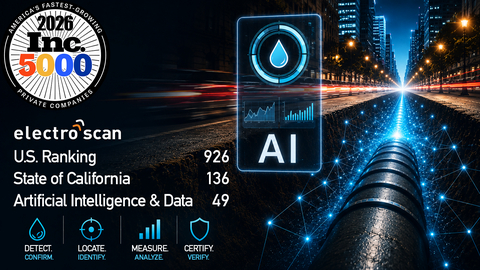
Electro Scan Inc., a leading provider of water loss measurement intelligence, has ranked nationally at #926 on the 2026 Inc. 5000 America’s Fastest-Growing Private Companies list.
Electro Scan achieved 373% revenue growth over the past three years, reflecting accelerating adoption of its proprietary inspection and measurement technologies by municipal water utilities, engineering firms, contractors, industrial asset owners, and international infrastructure operators.
The No. 49 national ranking in Artificial Intelligence & Data is particularly notable for a company serving the infrastructure-focused water and wastewater sector.
The recognition reflects Electro Scan’s evolution from an emerging inspection technology company into a rapidly scaling water loss measurement platform that integrates proprietary equipment, field services, AI-assisted analytics, cloud-based reporting, and regulatory compliance to deliver data intelligence for the global water industry.
The Inc. 5000 is an annual ranking of the fastest-growing privately held companies in the United States where ranking is according to percentage revenue growth over a three-year period and must satisfy Inc.’s eligibility and verification requirements.
“Being named to the Inc. 5000 validates the extraordinary work of our employees, customers, and business partners,” said Chuck Hansen, Chairman and Founder of Electro Scan Inc.
Hansen previously founded Hansen Information Technologies in 1983, which developed infrastructure management software used by public agencies and utilities before being acquired by Golden Gate Capital and INFOR Global in 2007. Later, Hansen’s pipeline and linear asset management products transitioned to Swedish-based Hexagon, then to US-based Octave Intelligence PLC.
Hansen launched Electro Scan in 2011 to commercialize electrical resistance technologies to assess buried pipelines using a physics-based approach to determine defect-level asset integrity, condition assessment, and rehabilitation effectiveness.
Building an AI-Ready Infrastructure Data Platform
Today, Electro Scan Inc. develops and deploys a machine-intelligent platform that automatically locates and quantifies leaks in pressurized water mains, gravity sewer, rising mains, stormwater pipelines, and industrial plants, without relying on visual observations, acoustic interpretations, predictive models or destructive excavation.
To the company’s knowledge, Electro Scan is the only commercially-available platform that can identify buried pipe materials, without digging, including copper, galvanized, plastic, and lead drinking water pipes.
Under federal mandate over 66,000 U.S. water providers must complete detailed inventories of their water service lines and replace all lead drinking water pipes by 2037.
As of August 1, 2026, Electro Scan’s operating metrics included:
- 44,790 completed inspections
- 21,443 residential and commercial water service line home inspections
- 775,103 individual defects, each identified with a unique GPM measurement
- 6,541 miles of pipeline assessed
- 2,997,128 gallons per minute in aggregate individual measured leak rates across completed inspections
Converted to a 24-hour equivalent basis, cumulative leakage measurements using Electro Scan’s platform has identified more than 4.3 billion gallons per day of water losses, or the equivalent of 4 times the daily water supply of New York City.
Every inspection expands Electro Scan’s proprietary infrastructure dataset, creating an increasingly valuable collection of measured leak-rates corresponding to buried pipe-material, defect-location and pipeline-performance data, commonly used for predictive modeling, digital twins, repair recommendations, infrastructure intelligence and AI-powered water network analytics.
Water Industry Shifts From Inference to Measurement
For more than a century, the water industry has relied on indirect methods to evaluate underground infrastructure.
- Acoustic sensors typically infer leaks from sound waves that may or may not correspond to a specific defect. And may be influenced by a variety of factors, including background noise, signal contamination, pipe material, groundwater levels, internal water pressure, cross-talk (i.e. when one signal overlaps another), vibration noise, navigational constraints and customer usage.
- Closed-Circuit Television (CCTV) cameras are typically used to inspect sewer and stormwater pipes to record visible surface conditions only, but are unable to correctly assess the water tightness of joints, service connection, or cracks.
- Satellites, pressure monitoring, tracer gases, data loggers and predictive models rely on secondary indicators that may not provide precise defect locations or quantify individual leak severity.
Multiple defects typically exist along the same pipeline, but legacy methods are typically not able to identify individual defects or certify post-rehabilitation work as leak-free.
A useful analogy is trying to understand 20 people speaking in the same room at the same time; all speaking into a single microphone.
The microphone confirms that people are talking, but determining exactly who is speaking, where each person is located and which voice matters most becomes increasingly difficult as the signals overlap.
Buried water and sewer systems present a similar challenge.
“Utilities no longer want to know whether a leak might exist,” Hansen said.
“They increasingly want to know where it is, how significant it is, whether a repair was successful and whether the result can be independently verified—measured in gallons per minute [GPM], before and after repair so a specific recovery amount can be validate and periodically tested for sustainability,” Hansen said.
As hyperscalers, such as Amazon, Google, Meta and Microsoft, seek to become Water Positive by 2030 (i.e. contributing more water than used), Electro Scan’s measurement platform is able to independently verify and validate data center claims.
The lack of auditable water accounting data has emerged as a potential stumbling block for utilities and hyperscalers. Especially in formulating credible responses to environmental activists, homeowners, local protesters, and regulators to battle a growing number of building moratoriums.
AI Begins With Better Data
Artificial intelligence (AI) is rapidly expanding across the water industry, but AI cannot overcome fundamental limitations in the underlying information presented to it.
For example, AI-CCTV inspection can document visible portions of a sewer pipe, but an image alone may not establish whether a crack is merely superficial or extends completely through the wall of the pipe.
Likewise, a camera traveling through a pipe cannot directly inspect hidden defects inside a joint’s bell-and-spigot or service connection, causing an under-reporting of defects that may result in the wrong recommended pipeline rehabilitation.
In 2025, Electro Scan, working in association with Hillsborough County, Florida, completed a four-year study finding 20% of its repairs leaked more after rehabilitation—using CCTV cameras to visually inspect and accept all work.
Applying artificial intelligence to visual data may accelerate visual defect classification and improve consistency, but AI cannot create physical information the original image or video never captured.
In contrast, Electro Scan’s AI Particle Tracing feature confirms all leak locations in pressurized water mains.
First, identifying leak locations using electrical resistance testing. Then, using a camera that is paused at a precise location to record a high resolution video that traces water particulates leaving the pipe.
Contamination of water pipelines from outside sources can also be traced confirming water flows entering the pipe.
“Our objective has never been to replace engineering judgment with artificial intelligence,” said Mike App, Executive Vice President, Electro Scan Inc.
“Our objective is to give artificial intelligence better engineering data—data capable of profiling defects, avoiding dry holes, selecting appropriate repairs and verifying rehabilitation actually delivered,” App said.
Growth Accelerated by Lead Service Line Identification
Electro Scan’s revenue growth has also been driven by one of the largest drinking water infrastructure initiatives in U.S. history.
The U.S. Environmental Protection Agency (USEPA)’s Safe Drinking Water Information System (SDWIS) Service Line Inventory Dashboard currently estimates that approximately 22.4 million water service lines (i.e. primarily limited to the utility-side of a customer’s water meter) are UNKNOWN.
While planning for lead pipe replacements must commence in 2027, utilities must also begin field verifications of all KNOWN and UNKNOWN pipe materials that connect homes & businesses to municipal water mains, representing nearly 100 million water service lines.
Recently, field testing of water service lines has revealed that plastic and copper pipes may test positive for lead, especially if upstream pipes ever supplied water through lead pipes and later removed.
Just like galvanized pipes can retain lead inside of tuberculated pipes, researchers have found that lead can also be stored inside of biofilms and calcified copper and plastic pipes.
As a result, many communities are discussing the need for a special ordinance for water service lines to be inspected as part of real estate transactions, similar to sewer line inspections.
Currently, Electro Scan’s SWORDFISH platform is used as the City of Baltimore’s lead service line inspection solution, completing more than 9,000 residential property inspections to date.
Other customers include Dallas Water Utilities, Chester Water Authority, Clear River Electric & Water District, City of Rock Hill, Town of Medley and Village of Pleasantville.
Electro Scan has also deployed SWORDFISH at universities, elementary schools, day care centers, commercial properties, including Bard College and United World College.
Commercial Expansion and Strategic Marketing Partnerships
The company recently entered into a sales and marketing partnership with Core & Main’s Damage Prevention Division.
Anchored by Fort Worth, Texas-based Green Equipment Company and New Jersey-based Eastcom Associates Inc., Core & Main is an authorized supplier of Electro Scan’s SWORDFISH Special Edition and Lead Trace products that help identify water service line materials and verify previously inventoried water lines that may have used predictive modeling or aboveground visual inspections.
International Validation and Expanding Intellectual Property
In 2024, Saudi Aramco Engineering Requirement No. 12366 was issued establishing engineering requirements for the inspection of non-metallic pipelines based on Electro Scan’s proprietary leak-detection technology.
Currently, Electro Scan believes the requirement demonstrates the potential application of electrical resistance testing not only to municipal water infrastructure, but also to critical industrial pipeline systems, worldwide.
Electro Scan’s intellectual property portfolio includes 22 issued U.S. and international patents covering electrical resistance testing, pipeline assessment, leak quantification, service line identification and machine-intelligent infrastructure analytics.
Positioned for the Next Generation of Water Infrastructure
The Inc. 5000 recognition comes as Electro Scan evaluates opportunities to accelerate commercial expansion, increase manufacturing capacity, broaden distribution, expand software and data services, and pursue strategic relationships throughout the global water infrastructure sector.
“The Inc. 5000 recognizes what Electro Scan has accomplished, but it also highlights the much larger opportunity ahead of us,” App said.
“Aging infrastructure, regulatory mandates, water scarcity and the need for verifiable performance data are creating sustained demand for technologies capable of measuring what traditional methods cannot,” App said.
About Electro Scan Inc.
Electro Scan Inc. develops machine-intelligent technologies for measuring, locating and assessing conditions in water, sewer and industrial pipelines. The company’s solutions provide utilities, engineers, contractors, industrial operators and infrastructure owners with repeatable, defect-level information supporting regulatory compliance, water-loss measurement, pipe-material identification, rehabilitation verification, asset management and infrastructure investment planning.
Electro Scan is headquartered in Sacramento, California, and supports customers and partners throughout the United States and international markets. For more information, visit www.electroscan.com.
View source version on businesswire.com: https://www.businesswire.com/news/home/20260811429715/en/
Media gallery