Automotive Data Logger Market to Reach USD 10.32 Billion by 2035, Growing at 8.24% CAGR
Autonomous driving R&D is the fastest-growing application segment in the Automotive Data Logger Market, forecast to
Press Release Disclaimer: This is a press release distributed through the XPR Media network. It has not been independently verified by our newsroom.

Autonomous driving R&D is the fastest-growing application segment in the Automotive Data Logger Market, forecast to expand at a 14.0% CAGR through 2035.
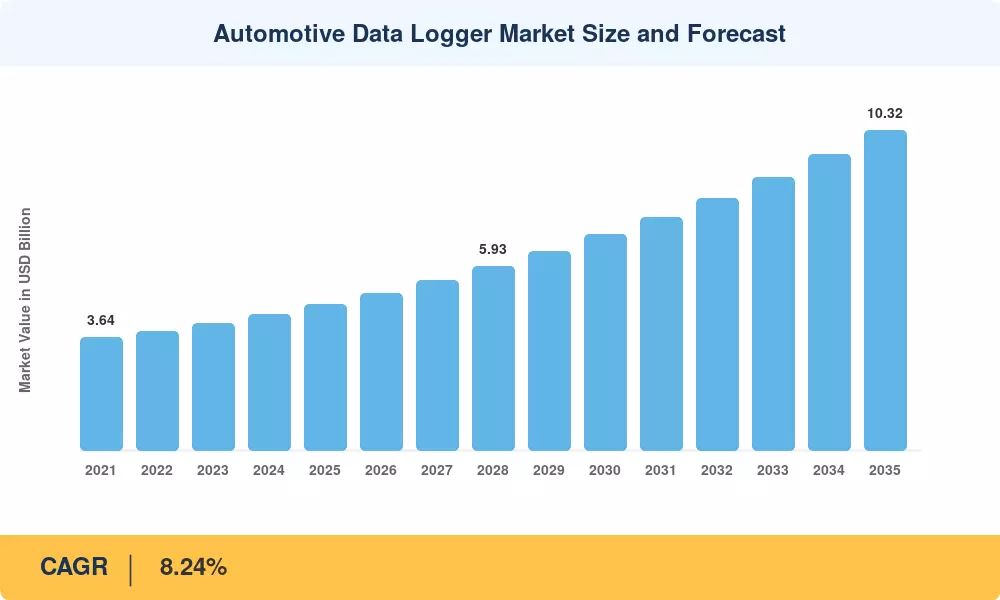
NEW YORK, NY, UNITED STATES, August 27, 2026 /EINPresswire.com/ — According to Market Research Future, the Automotive Data Logger Market is projected to reach USD 5.06 Billion in 2026, climbing to USD 10.32 Billion by 2035 at a CAGR of 8.24% during the 2026–2035 period, driven by integration of advanced telematics and real-time data analytics. This significant growth reflects the increasing reliance on data-driven decision-making across the automotive ecosystem, where data loggers have become indispensable tools for vehicle development, validation, and operational optimization.
Market Overview
Automotive data loggers are sophisticated electronic devices designed to capture, store, and transmit vehicle performance data from various sensors, electronic control units, and communication networks. These systems play a critical role in recording parameters such as engine performance, vehicle speed, brake application, steering angle, battery status, and sensor readings across multiple vehicle subsystems. The data collected serves diverse purposes ranging from simple performance evaluation to complex development of advanced driver assistance systems and autonomous driving technologies .
The key growth drivers propelling this market expansion include the rapid proliferation of electric vehicles and autonomous driving systems, which generate vast volumes of sensor, battery, and communication data requiring robust logging systems for validation, diagnostics, and monitoring . Regulatory mandates for crash data recording, emissions testing, and safety compliance are driving adoption of data logging hardware across vehicle segments . Fleet operators are increasingly seeking predictive maintenance capabilities, usage-based insurance solutions, and real-time diagnostics, pushing demand for embedded loggers and connectivity features . Original equipment manufacturers and Tier-1 suppliers favor data-driven development cycles, continuous validation, and over-the-air updates, all of which rely on reliable vehicle data capturing .
Technological developments are reshaping the data logger landscape at an accelerating pace. Advances in connectivity including 5G and edge computing, cloud platforms, and data analytics enable richer services layered on logger hardware, increasing overall value . The rise of software-defined vehicles and vehicle-level architectures emphasizes the centrality of data logging to system observability and traceability . Hybrid logger architectures combining edge and cloud capabilities optimize data flow and reduce costs, while modular and scalable logging platforms that adapt across product lines and vehicle classes ease deployment challenges .
📍 Get Free Sample Report for Detailed Market Insights:
https://www.marketresearchfuture.com/sample_request/6676
Market Segmentation
The automotive data logger market is segmented based on application, connection type, hardware type, memory capacity, end user, channel, vehicle type, and propulsion to provide comprehensive insights into the industry landscape.
By Application: The market is categorized into ADAS, Autonomous Driving R&D, Powertrain Diagnostics, Vehicle Dynamics & Chassis, and Fleet & Telematics. The ADAS and safety segment is estimated to hold a dominant position, as data loggers capture real-time data from vehicle sensors and components to help engineers analyze vehicle behavior in various scenarios, enabling fine-tuning of algorithms for adaptive cruise control, lane departure warning, and collision avoidance systems . In autonomous driving research and development, data loggers are essential for capturing and processing the massive data volumes required for training and validating self-driving algorithms. Powertrain diagnostics applications leverage data loggers to monitor engine and transmission performance, enabling early detection of issues and predictive maintenance. Fleet and telematics applications utilize data loggers to track vehicle location, driver behavior, fuel consumption, and maintenance needs, improving operational efficiency and safety .
By Connection Type: The market is segmented into USB, Automotive Ethernet, CAN/CAN FD, Wireless (Wi-Fi/Cellular), and SD Card/PCMCIA. Bluetooth and Wi-Fi connections play crucial roles by facilitating seamless data transfer between the logger and external devices, enabling real-time monitoring and data retrieval . Wi-Fi connectivity expands the range and versatility of data logger applications, enabling remote access and data transfer over longer distances, and facilitating integration with cloud-based platforms for data storage, analysis, and sharing . The CAN and CAN FD segment dominates the global market, as Controller Area Network enables communication between various vehicle electronic control units, facilitating data exchange for monitoring and controlling systems like engine management, transmission, and safety features . CAN FD offers increased bandwidth by allowing longer data frames, addressing the need for higher data transfer rates as automotive systems become more complex .
By Hardware Type: The market is divided into Stand-Alone Data Logger, Embedded/Integrated Logger, Cloud-Based Software Agent, and PC-Based Logger. Stand-alone data loggers are portable devices used primarily in testing and validation environments, offering flexibility and ease of deployment. Embedded or integrated loggers are built directly into vehicle electronic architectures, providing continuous data capture during normal vehicle operation. Cloud-based software agents enable remote data collection and analysis, leveraging cloud computing infrastructure for scalable data processing. PC-based loggers are used in development and testing environments, offering comprehensive data visualization and analysis capabilities.
By Memory Capacity: The market is segmented into Less Than 32 GB, 32–128 GB, 128–512 GB, and Above 512 GB. The choice of memory capacity depends on the specific application requirements, with higher capacities needed for continuous high-resolution logging in ADAS and autonomous driving applications.
By End User: The market serves Original Equipment Manufacturers, Tier 1/Tier 2 Suppliers, Fleet Operators, and Independent Test Labs. Regulatory bodies also utilize automotive data loggers to enforce compliance with safety and environmental laws, collecting data on speed, acceleration, emissions, and system performance to ensure vehicles adhere to established standards . OEMs constitute the largest end-user segment, utilizing data loggers extensively in vehicle development, testing, and validation processes.
By Channel: The market is categorized into OEM-Fitted and Aftermarket channels. OEM-fitted loggers are integrated into vehicles during manufacturing, while aftermarket loggers are installed post-production for specific applications including fleet management, usage-based insurance, and performance monitoring.
By Vehicle Type: The market covers Passenger Cars, Light Commercial Vehicles, and Heavy Commercial Vehicles. Passenger cars dominate in terms of volume, driven by high production volumes and increasing integration of electronic systems in consumer vehicles.
By Propulsion: The market is segmented into ICE Vehicles, Battery Electric Vehicles, and Hybrid Electric Vehicles. Electric vehicles represent a significant growth opportunity, as they require extensive data logging for battery performance monitoring, thermal management, and range optimization.
By Region: The market analysis covers North America, Europe, South America, Asia Pacific, and the Middle East and Africa, providing comprehensive geographic insights into regional dynamics and growth opportunities.
🛒 You can buy this market report at:
https://www.marketresearchfuture.com/checkout?currency=one_user-USD&report_id=6676
Regional Analysis
North America currently accounts for a dominant share of the global automotive data logger market and is expected to retain its leadership position throughout the forecast period. The region’s dominance is attributed to frequent technological advances, enthusiasm shown by vendors to adopt latest technologies, rising uptake of electric cars due to environmental concerns, and early adoption of innovations . The use of high-performance vehicles requiring advanced technologies such as ECUs, sensors, and cameras for testing and diagnosis further supports market growth, as these components are largely manufactured in the region . Stringent regulatory mandates regarding vehicle safety and emissions in North America drive adoption of data logging solutions for compliance and reporting purposes . The burgeoning automotive aftermarket and proliferation of electric vehicles further boost demand for data loggers to monitor battery performance and vehicle efficiency . Market players showcase their novel products at public events to demonstrate capabilities and build market awareness .
Europe holds the second-largest share of the global automotive data logger market, driven by fast adoption of electronic architectures in the auto industry and increasing sales of electric cars . The presence of leading economies like France, UK, and Germany, coupled with developing nations like Russia and Turkey that represent large automobile markets, contributes to regional growth. The region being a hub for adoption of advanced features in automobiles, rapid industrialization, and infrastructural developments further supports market expansion . Germany, France, Italy, and Spain support demand through OEM production, electrification strategies, and regional supplier networks, while Russia’s market focuses on localization, heavy-duty vehicles, diagnostic self-reliance, and domestic supply resilience .
Asia Pacific is predicted to experience healthy growth in the automotive data logger market, driven by the region being the hub for automobile production, rapid industrialization, and infrastructural developments . China is one of the largest demand centers because of electric vehicle scale, intelligent cockpit adoption, battery testing needs, and connected vehicle policy momentum . India is gaining traction through expanding passenger vehicle production, EV startups, and automotive engineering services . Japan and South Korea remain advanced markets for hybrid systems, battery platforms, ADAS, sensors, precision manufacturing, and high-reliability vehicle electronics . Australia contributes through harsh-environment testing, mining fleets, long-distance logistics, and commercial vehicle monitoring .
South America and the Middle East and Africa represent emerging markets with growing potential. The Automotive Event Data Recorder Market has seen increasing relevance in these regions, as regulatory frameworks for crash data recording and safety compliance continue to evolve. Key industry players are focusing on developing region-specific offerings for EV battery testing, ADAS validation, commercial fleet diagnostics, event data recording, and ruggedized environmental use cases .
Competitive Landscape and Key Players
The automotive data logger market is highly competitive, featuring a mix of established automotive suppliers, technology specialists, and regional players competing for market share. The competitive landscape is characterized by technological innovation, strategic partnerships, and portfolio expansion.
Key players operating in this market include Robert Bosch GmbH, Continental AG, Vector Informatik GmbH, National Instruments Corporation, TTTech Computertechnik AG, Intrepid Control Systems Inc., Racelogic, Danlaw Technologies India Limited, Dewesoft d.o.o., Ipetronik GmbH & Co. KG, HEM Data Corporation, Xilinx, Harman International, and MEN Micro Inc. . These industry leaders are investing heavily in research and development to create advanced data logging solutions that support high-speed in-vehicle networks, secure data transmission, and cloud integration.
Strategic developments are reshaping the competitive landscape. In January 2024, Continental released a new high-speed data logger tailored for electric and autonomous vehicle testing, with support for multi-bus capture including CAN, Ethernet, and FlexRay, along with real-time data streaming to cloud platforms . In February 2024, Ipetronik launched the M-LOG V3+, a compact data logger featuring LTE, GPS, CAN FD, and multi-analog sensor support, oriented toward remote fleet diagnostics and distributed testing . In October 2023, Xylon showcased its comprehensive fourth-generation datalogger, Quattro, at the Automotive Testing Expo North America, demonstrating data collection from multiple video sources with varying specifications including cameras equipped with FPD-Link III and GMSL2 automobile interfaces, GigE Vision, and USB reference cameras .
Innovation and technology initiatives are accelerating across the industry. Companies are developing platforms that support CAN FD and Automotive Ethernet while maintaining backward compatibility with legacy protocols such as CAN, LIN, and FlexRay . Scalable storage, secure boot, encryption, authenticated data transfer, tamper resistance, and time-synchronized recording are being designed into platforms from the start to meet cybersecurity, safety, and regulatory expectations . The Vehicle Tracking System Market has seen parallel growth, with data logging capabilities increasingly integrated into comprehensive fleet management and vehicle tracking solutions.
Latest Industry News and Developments
Recent industry developments highlight the dynamic nature of the automotive data logger market. In July 2025, Robert Bosch expanded its data analytics capabilities through the acquisition of a software startup specializing in machine learning algorithms for automotive applications. This acquisition is indicative of Bosch’s strategy to integrate cutting-edge technologies into its data logging solutions, enhancing value proposition for customers. By leveraging machine learning, Bosch aims to improve the accuracy and efficiency of data analysis, crucial for optimizing vehicle performance and safety .
In the first quarter of 2025, Racelogic opened a new state-of-the-art manufacturing facility in Buckingham, UK, to increase production capacity for its automotive data logging products in response to growing global demand . In the second quarter of 2025, Xylon launched a new automotive data logger designed for embedded AI training and validation, supporting wide-band sensor data capture for autonomous driving applications . Intrepid Control Systems announced the launch of a wireless automotive data logger supporting high-speed multi-channel interfaces, targeting OEMs and Tier 1 suppliers developing next-generation vehicles .
In the third quarter of 2024, Continental and NVIDIA announced a strategic partnership to co-develop advanced automotive data logging systems, leveraging NVIDIA’s AI platform to enhance vehicle diagnostics and safety compliance . These strategic collaborations between automotive suppliers and technology companies are increasingly shaping the competitive landscape, fostering innovation and collaboration across the industry .
Market Challenges and Opportunities
The automotive data logger market faces several key challenges that could impact growth trajectories. Handling massive data volumes generated by modern vehicles balancing fidelity, storage capacity, and bandwidth constraints represents a significant challenge . Ensuring data security, integrity, and tamper-resistance is critical, especially for safety or regulatory logging use cases . Achieving interoperability across multiple vehicle buses, ECUs, and vendor domains remains difficult, and managing power constraints, thermal design, and durability in harsh automotive environments is nontrivial . Upgrading or maintaining logging firmware compatibility over vehicle lifetimes of ten years or more is complex, and convincing OEMs and consumers to accept logging, especially in privacy-sensitive regions, may face resistance . Variance in regulatory regimes across countries complicates global rollouts, and investments in cloud infrastructure and analytics platforms may be costly for hardware providers . High cost of high-speed, ruggedized logger hardware and secure storage increases barriers for some OEM or aftermarket deployments . Data privacy, security, and regulatory compliance may restrict logging detail or access, especially in consumer vehicles, and some regions lack supporting infrastructure including cellular and edge compute to enable connected logging .
Emerging opportunities are abundant in the evolving mobility landscape. One opportunity lies in analytics-as-a-service, pairing logging hardware with cloud analytics, predictive insight, and service subscriptions . Aftermarket retrofitting enables existing vehicles to gain logging capabilities for diagnostics, usage-based insurance, or fleet telematics . Expansion into emerging markets with increasing vehicle electrification and fleet modernization offers untapped demand, while partnerships with autonomous vehicle developers, OEM validation labs, and ADAS platforms can create integrated logging ecosystems . The shift to software-defined vehicles offers loggers a role in domain controllers, modular electronics, and distributed data architectures . Hybrid logger architectures combining edge and cloud capabilities can optimize data flow and reduce cost, while modular and scalable logging platforms that adapt across product lines and vehicle classes can reduce cost and ease deployment .
To explore more market insights, visit us at:
https://www.marketresearchfuture.com/reports/automotive-data-logger-market-6676
Final Market Summary
The transformation from traditional test and measurement devices to integrated, connected data logging platforms represents a fundamental industry evolution, positioning data loggers as essential components of the broader automotive technology ecosystem. As vehicles increasingly become connected, electric, and software-defined, the role of data loggers will continue to expand, ensuring sustained relevance and growth throughout the forecast period and beyond.
More Related Reports from MRFR Library:
Automobile Oxygen Sensor Market : https://www.marketresearchfuture.com/reports/automobile-oxygen-sensor-market-29750
Automotive In Wheel Market : https://www.marketresearchfuture.com/reports/automotive-in-wheel-market-29787
Auto Leasing Service Market : https://www.marketresearchfuture.com/reports/auto-leasing-service-market-29802
Automotive Wireless Charger Market : https://www.marketresearchfuture.com/reports/automotive-wireless-charger-market-29815
Car Refrigerator Market : https://www.marketresearchfuture.com/reports/car-refrigerator-market-29819
Car Satellite Antenna Market : https://www.marketresearchfuture.com/reports/car-satellite-antenna-market-29824
Automotive Warranty Management Software Market : https://www.marketresearchfuture.com/reports/automotive-warranty-management-software-market-29826
Autonomous Bus Market : https://www.marketresearchfuture.com/reports/autonomous-bus-market-29832
Cng Lng Commercial Vehicle Market : https://www.marketresearchfuture.com/reports/cng-lng-commercial-vehicle-market-29835
Automotive Crash Test Dummy Market : https://www.marketresearchfuture.com/reports/automotive-crash-test-dummy-market-29950
Market Research Future
Market Research Future
+1 855-661-4441
email us here
Legal Disclaimer:
EIN Presswire provides this news content “as is” without warranty of any kind. We do not accept any responsibility or liability
for the accuracy, content, images, videos, licenses, completeness, legality, or reliability of the information contained in this
article. If you have any complaints or copyright issues related to this article, kindly contact the author above.

Media gallery