A picture of average American debt, according to Credit Karma data
Intuit Credit Karma reports average American debt reached $60,112 in mid-2026, with Gen Z seeing the fastest growth,
Press Release Disclaimer: This is a press release distributed through the XPR Media network. It has not been independently verified by our newsroom.



Pla2na // Shutterstock
A picture of average American debt, according to Credit Karma data
A new report provides a snapshot of average American debt, based on a July 2026 study of more than 107.3 million Intuit Credit Karma members with a combined overall debt of more than $10.6 trillion. The report is not a comprehensive view of debt across the entire U.S. population. Overall debt is defined as any type of debt noted on a member’s credit report. This includes credit card, mortgage, student loan, medical loan, auto lease and auto loan debt.
Below, Intuit Credit Karma shares key insights from the report.
Credit Karma Statistic Snapshot

Intuit Credit Karma
How much debt does the average American have?
Average overall debt continued to climb in the first half of 2026. Between April and June 2026, average overall debt among Credit Karma members rose to $60,112, a 2.38% increase from October through December 2025. Average debt increased in three of the four major debt categories in Q2 2026, with student loan debt growing the most (6.30%) once again.
Gen Z continues to see the fastest-growing average debt; data points to increased financial hardship
Generation Z again posted the fastest-growing average debt of any generation between the fourth quarter of 2025 and the second quarter of 2026, leading all generations in debt growth for:
- Student loans (10.47%)
- Auto loans (2.98%)
- Mortgage debt (2.64%)
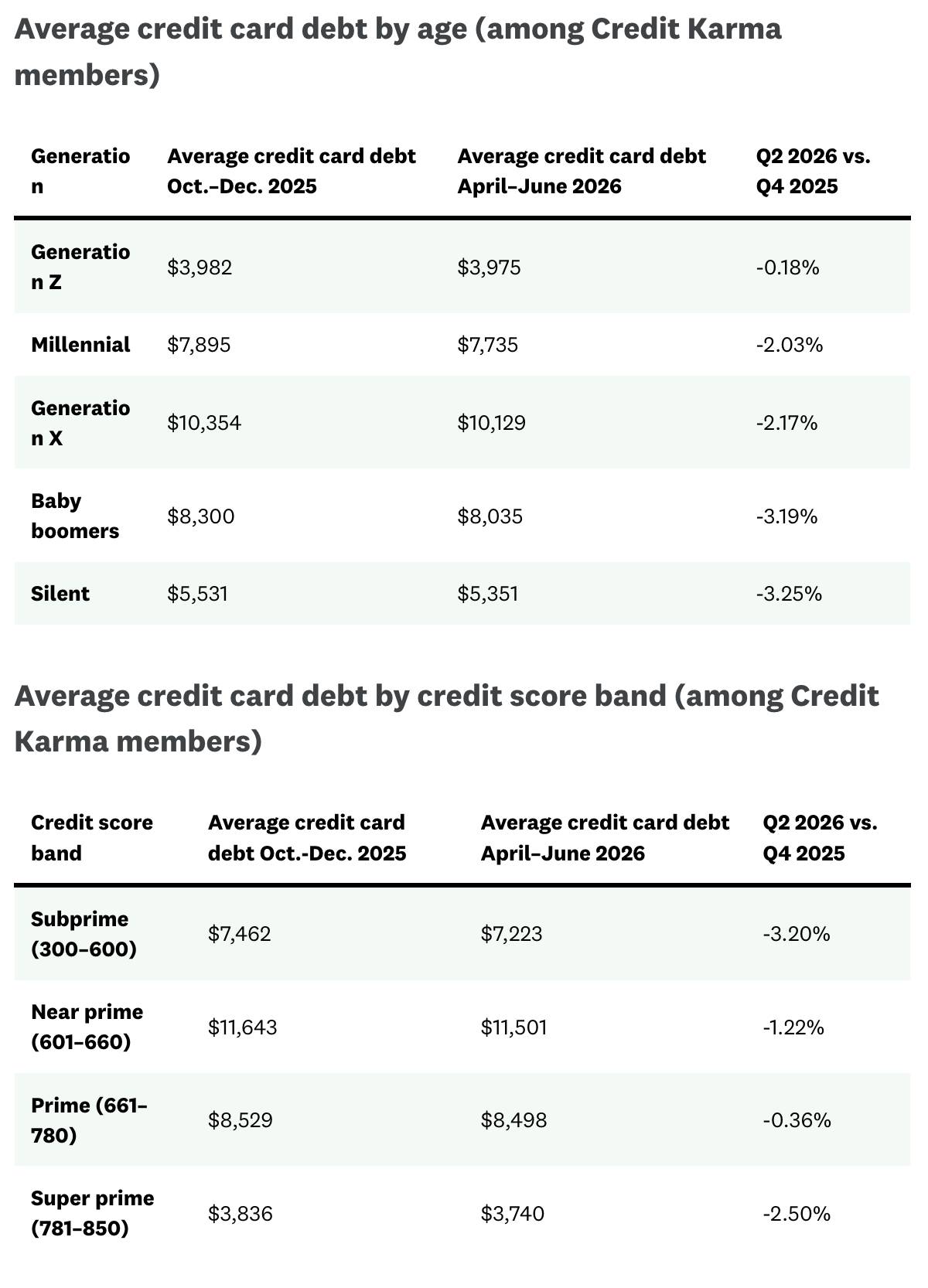
Notably, Gen Z’s average credit card debt was essentially flat (-0.18%), indicating they may be pulling back on card usage as their debt in other categories grows. This generation also saw a slight uptick in average open collections.
Average student loan debt saw the sharpest jump of any category
Average student loan debt accelerated, rising 6.3% in the first half of 2026 — an increase nearly equal to the 7.59% year-over-year growth in Q4 2025. Debt among subprime borrowers grew the most: up 9.76% in Q2 2026 from Q4 2025.

Intuit Credit Karma
How much credit card debt does the average American have?
In the second quarter of 2026, more than 102 million Credit Karma members with at least one credit card held a total of approximately $615.6 billion in credit card debt, up 4.5% from about $589 billion in Q4 2025. Average credit card debt fell to $7,685 in Q2 2026, down 2.30% from $7,866 in Q4 2025 — the only debt category with a decline in the first half of the year.
Intuit Credit Karma
Average auto loan debt in America
In the second quarter of 2026, nearly 74 million members with at least one open auto loan held more than $1 trillion in loan debt. The average auto loan balance among members rose to $26,359 in Q2 2026, a 2.14% increase from $25,806 in Q4 2025.

Intuit Credit Karma
Average mortgage debt in America
From April through June 2026, nearly 40 million members with at least one mortgage held a total of more than $8.09 trillion in mortgage debt. The average mortgage balance among members rose to $274,987 in Q2 2026, a modest 0.96% increase from $272,382 in Q4 2025. This represents the smallest increase across the four debt categories.

Intuit Credit Karma
What is the average student loan debt?
Nearly 34 million Credit Karma members with at least one open student loan held a total of more than $825.6 billion in student loan debt in the second quarter of 2026. The average student loan balance among members rose to $36,217 in the first half of the year — up 6.30% from $34,072 in Q4 2025. This represents the largest increase across the four debt categories, driven in large part by Gen Z (up 10.47% in Q2 vs. Q4).

Intuit Credit Karma
What is the average credit score?
The average VantageScore 3.0 credit score for members with debt rose to 676 in the first half of 2026, up three points from 673 in Q4 2025 — a reversal of the year-over-year decline in Q4 2025. Average scores rose for every generation except the Silent generation, which slipped one point.

Intuit Credit Karma
Accounts in collections
Among Credit Karma members with accounts in collections, the average number of open accounts remained relatively flat, with slight increases for the younger generations and members in the prime score band.
For this report, accounts in collections are any credit card, mortgage, student loan, medical loan, auto lease or auto loan accounts that have been sent to collections agencies, according to members’ credit reports. Creditors may have different standards for when they transfer debt to collections, but the typical cutoff is 120 to 150 days past due. For this report, researchers were able to determine if an account is in collections, but not how many days past due.
Keep in mind that this measure only looks at members who have open accounts in collections, not the member population as a whole. That means that it only captures people who are already potentially struggling with their finances.

Intuit Credit Karma
Average credit inquiries
For this report, credit inquiries are applications for new credit, such as credit cards or loans. In the second quarter of 2026, average inquiries fell slightly or remained flat across generations and score bands, continuing a years-long trend that suggests Americans are pulling back on new credit applications as they manage rising debt and an uptick in collections.

Intuit Credit Karma
Methodology
This report drew on insights from the aggregated reports of roughly 107.4 million Credit Karma users. All aggregate data analyzed was pulled on July 13, 2026, from members’ TransUnion credit reports. Averages were based on information from the previous 90 days.
This story was produced by Intuit Credit Karma and reviewed and distributed by Stacker.